Expand to India Without Incorporation by (Employer of Record) EOR services in India in 2026: A Complete EOR Guide
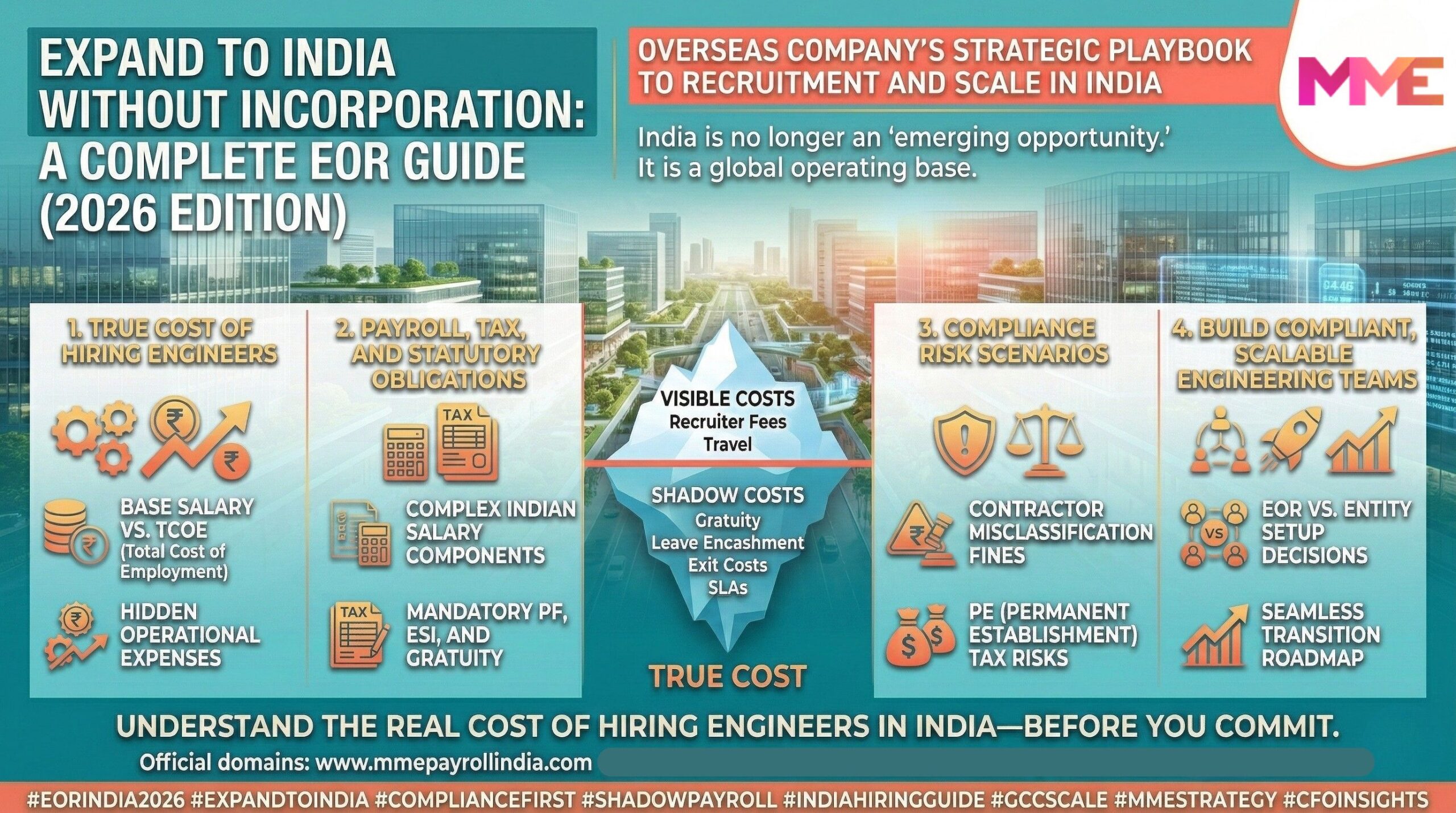
India is no longer an “emerging opportunity.”
It is a global operating base.
From engineering and product development to finance, design, analytics, and customer success, global companies are increasingly looking to hire in India—not as an experiment, but as a long-term growth strategy.
Yet one question keeps decision-makers stuck:
How do we expand to India without setting up a legal entity, managing payroll India complexities, or risking compliance India issues?
This is where an EOR (Employer of Record) services in India in 2026 becomes a strategic enabler—not a workaround.
This guide breaks down exactly how to expand to India without incorporation, what risks to avoid, and how EOR helps you hire faster, stay compliant, and scale with confidence.
Why Global Companies Are Looking to Hire in India
India offers a rare combination that few markets can match:
- A deep, diverse, English-speaking talent pool
- Strong technical and managerial capabilities
- Cost efficiency without compromising quality
- Time-zone alignment for global operations
- A fast-growing digital and innovation ecosystem
Whether you’re a startup testing the market or an enterprise building distributed teams, the ability to hire in India quickly can create a significant competitive advantage.
But opportunity without structure leads to risk.
The Real Challenge: Expansion Without Incorporation
Setting up a legal entity in India is not impossible—but it is:
- Time-consuming (often 3–6 months)
- Capital-intensive
- Legally complex
- Overkill for small or mid-sized teams
More importantly, incorporation exposes companies to long-term regulatory obligations—even if the market experiment doesn’t work.
This is why many global companies are choosing EOR services in India in 2026 as a first (and often preferred) mode of entry.
What Is an Employer of Record (EOR)?
An Employer of Record is a local entity that legally employs talent on your behalf.
You control:
- Day-to-day work
- Performance management
- Deliverables and team culture
The EOR manages:
- Employment contracts
- Payroll India processing
- Statutory benefits
- Tax deductions
- Compliance India requirements
- Labour law adherence
In simple terms:
You get the talent. The EOR handles the risk.
How EOR Enables You to Hire in India Without Incorporation
1. Immediate Market Entry
With an EOR, you can hire in India within weeks—not months.
There’s no need to:
- Register a company
- Open a local bank account
- Appoint directors or auditors
This speed is critical for companies competing for top talent or responding to market demand.
2. Legally Compliant Employment from Day One
India’s labour ecosystem includes:
- Central labour laws
- State-specific regulations
- Mandatory social security contributions
- Complex tax structures
EOR ensures:
- Employment contracts aligned with Indian law
- Accurate payroll India execution
- Ongoing compliance India across statutory filings
This removes guesswork and significantly reduces legal exposure.
3. Flexible Scaling Without Long-Term Commitment
One of the biggest advantages of EOR is flexibility.
You can:
- Start with 1 employee or 50
- Scale up or down based on business needs
- Exit the market cleanly if required
All without the sunk cost and rigidity of incorporation.
Understanding Payroll India: Why It’s Not Just Salary Processing
Payroll India is far more complex than paying monthly wages.
It includes:
- Income tax (TDS) calculations
- Provident Fund (PF) contributions
- Employee State Insurance (ESI), where applicable
- Professional tax (state-specific)
- Statutory bonuses and leave encashments
- Payroll reporting and filings
Errors in payroll don’t just upset employees—they trigger compliance risks.
A reliable EOR ensures:
- Accurate, on-time salary payments
- Full statutory compliance
- Transparent payroll reporting for your finance team
For global CFOs and founders, this clarity is invaluable.
Compliance India: The Hidden Risk Most Companies Underestimate
Compliance India is where many global expansions fail quietly.
Common risks include:
- Misclassification of employees as contractors
- Incorrect employment contracts
- Missed statutory filings
- Non-compliance with state labour laws
- Improper termination processes
These issues may not surface immediately—but when they do, the consequences can include penalties, disputes, and reputational damage.
An EOR acts as a compliance shield, ensuring that every hire, payroll cycle, and exit follows Indian labour law.
EOR vs Entity Setup: A Strategic Comparison
| Aspect | EOR Model | Local Incorporation |
| Time to hire | 2–4 weeks | 3–6 months |
| Upfront cost | Low | High |
| Compliance burden | Managed by EOR | Fully yours |
| Flexibility | High | Low |
| Exit complexity | Simple | Complex |
| Ideal for | Market entry, scaling | Long-term large operations |
For most companies entering India, EOR services in India in 2026 is the smarter first move.
Who Should Use an EOR in India?
EOR is particularly effective for:
- Startups expanding globally
- SaaS and tech companies building remote teams
- Engineering and product organisations
- Consulting and professional services firms
- Companies testing the Indian market before incorporation
If your priority is speed, compliance, and optionality, EOR fits.
Common Myths About Hiring in India via EOR
“EOR means less control over employees”
False. You manage the work; EOR manages employment compliance.
“EOR is only for small teams”
Not true. Many companies manage 50–200+ employees via EOR.
“EOR is more expensive than incorporation”
Only if you ignore the hidden costs of compliance failures, delays, and overhead.
Turning India Expansion Into a Growth Advantage
When done right, hiring in India is not just cost-efficient—it’s transformational.
Companies using EOR successfully:
- Build high-performing global teams
- Accelerate product and service delivery
- Reduce operational risk
- Maintain leadership focus on growth
Instead of wrestling with payroll India and compliance India complexities, leadership teams stay focused on execution.
When Should You Transition From EOR to Entity?
EOR doesn’t lock you in.
Many companies:
- Start with EOR
- Validate the market
- Build leadership teams
- Then incorporate when scale justifies it
A good EOR partner supports this transition smoothly—without disrupting employees.
Final Thoughts: Expansion Without Risk Is Possible
Expanding to India no longer requires heavy upfront investment or regulatory exposure.
With the right EOR partner, you can:
- Hire in India confidently by EOR services in India in 2026
- Run payroll India accurately
- Stay compliant with India’s evolving regulations
- Scale at your own pace
The smartest global companies don’t ask,
“Can we afford to expand to India by EOR services in India in 2026?”
They ask,
“How fast can we do it—without unnecessary risk?”
EOR is the answer.
Ready to Hire in India Without Incorporation?
If you’re exploring:
- Your first hire in India
- Scaling an Indian team
- Simplifying payroll India and compliance India
An EOR-led expansion strategy can help you move faster, safer, and smarter.
Because global growth should feel strategic—not stressful.