
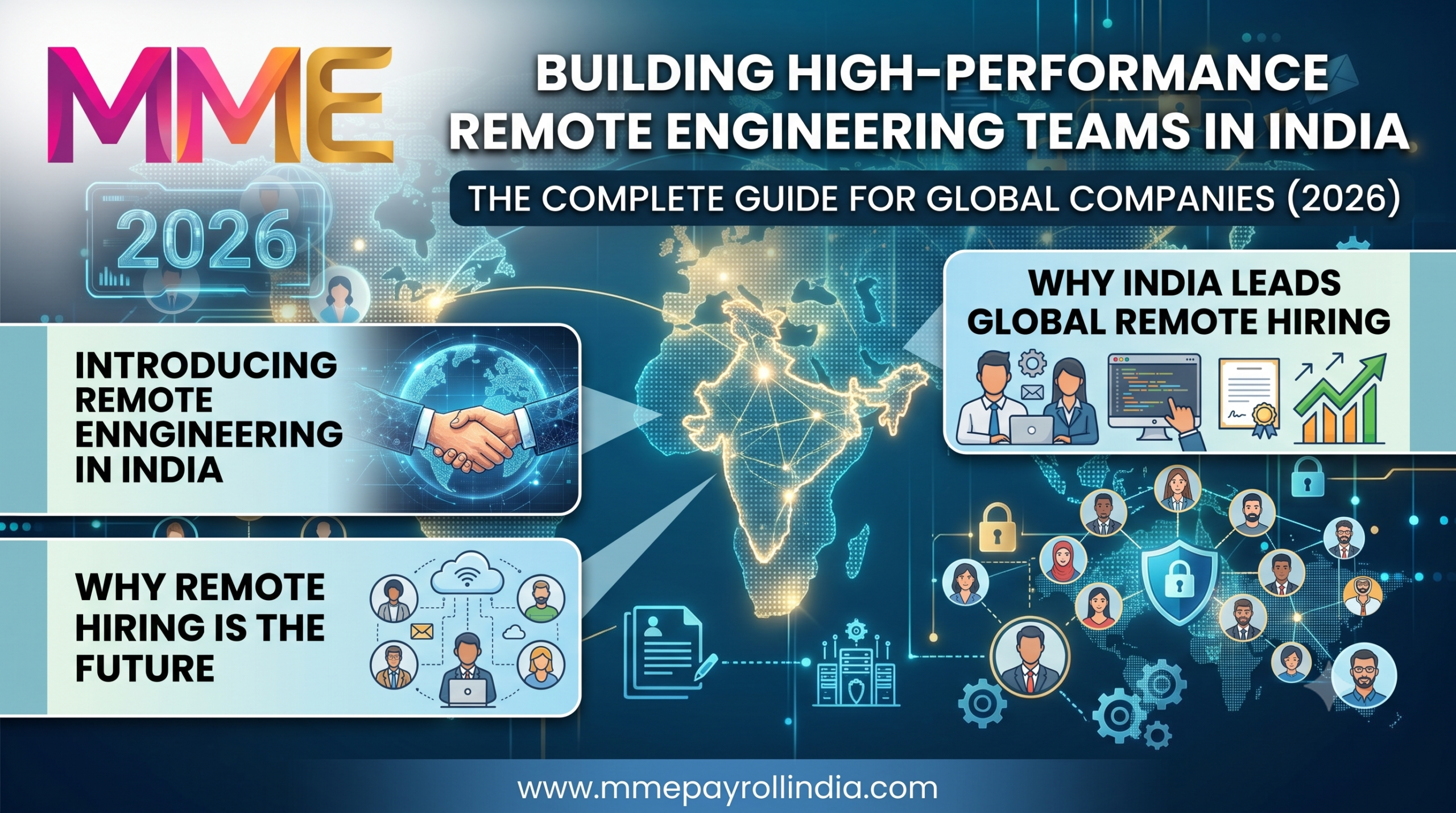
Remote Engineering Teams in India: The Complete Guide for Global Companies (2026)
Introduction, Why Remote Hiring Is the Future & Why India Leads Global Remote Hiring
The way companies build engineering teams has changed dramatically over the last decade. Businesses are no longer limited to hiring talent within commuting distance of their offices. Advances in cloud technology, collaboration platforms, secure development environments, and digital project management have enabled organizations to build highly productive engineering teams across borders.
As businesses compete in an increasingly digital economy, access to skilled talent has become one of the most important drivers of innovation and growth. However, companies in the United States, Germany, the United Kingdom, Canada, Australia, and many other countries continue to face persistent shortages of experienced software developers, AI engineers, cloud specialists, DevOps professionals, and cybersecurity experts.
To overcome these challenges, global organizations are increasingly looking beyond domestic talent markets. India has emerged as one of the world’s most trusted destinations for remote engineering teams, offering a combination of technical expertise, scalability, cost efficiency, and a mature technology ecosystem.
Whether a company wants to hire five developers for a new SaaS platform or establish a dedicated engineering center with hundreds of professionals, India provides the infrastructure and talent needed to support long-term business growth.
This comprehensive guide explains why remote hiring has become the preferred workforce strategy, why India continues to lead global engineering recruitment, and how businesses can successfully build high-performing remote engineering teams in 2026.
Why Remote Hiring Is the Future
Remote work is no longer viewed as a temporary solution. It has evolved into a long-term business strategy adopted by startups, mid-sized enterprises, and multinational corporations alike.
Organizations have realized that innovation is not limited by geography. Instead, success depends on hiring the right people regardless of where they live.
Several factors are driving this shift.
Access to a Global Talent Pool
Many organizations struggle to recruit specialized engineers within their local markets. Competition for experienced developers, AI specialists, and cloud architects remains intense, leading to extended hiring cycles and increasing salary expectations.
Remote hiring removes geographical barriers, enabling companies to recruit professionals with the precise technical skills they require rather than limiting recruitment to a single city or country.
Instead of competing for a small local talent pool, businesses gain access to millions of qualified professionals worldwide.
Faster Hiring
Hiring locally can often take several months due to talent shortages and high competition.
By expanding recruitment internationally, organizations significantly increase the number of available candidates, allowing hiring managers to identify suitable professionals more quickly.
This accelerated recruitment process helps businesses launch products faster, meet project deadlines, and respond rapidly to changing market conditions.
Improved Business Flexibility
Modern businesses frequently experience fluctuations in hiring requirements.
A startup may require five developers today and twenty additional engineers within six months. Similarly, a global enterprise may need to expand engineering capacity rapidly for a major product launch.
Remote hiring enables organizations to scale engineering teams according to business requirements without the long-term commitments associated with opening multiple physical offices.
Business Continuity
Distributed engineering teams reduce operational risks by preventing reliance on a single geographic location.
Organizations with globally distributed teams are generally better positioned to maintain productivity during regional disruptions, natural disasters, transportation challenges, or local workforce shortages.
This resilience has become an important component of long-term workforce planning.
Cost Optimization
Hiring internationally also allows organizations to optimize operational costs without compromising quality.
Rather than reducing investment in engineering, companies can allocate budgets more strategically by building teams in regions with strong technical capabilities and competitive employment costs.
These savings often support additional hiring, research and development, employee training, and product innovation.
Why India Leads Global Remote Hiring
India has become one of the most attractive destinations for global engineering recruitment.
The country’s technology ecosystem has matured significantly over the past two decades, making it a preferred location for multinational corporations, technology startups, Global Capability Centers (GCCs), and offshore engineering teams.
One of the World’s Largest Engineering Talent Pools
India produces a substantial number of engineering and technology graduates every year across disciplines such as:
- Computer Science
- Information Technology
- Artificial Intelligence
- Machine Learning
- Data Science
- Electronics Engineering
- Mechanical Engineering
- Cloud Computing
- Cybersecurity
- Robotics
In addition to new graduates, India has an extensive workforce of experienced software professionals who have contributed to global technology projects across industries.
This depth of talent enables companies to recruit both entry-level professionals and highly experienced engineering leaders.
Strong Technical Expertise
Indian engineers are recognized globally for their expertise in modern technologies, including:
- Artificial Intelligence
- Generative AI
- Machine Learning
- Cloud Computing
- DevOps
- Full-Stack Development
- Mobile Application Development
- Data Engineering
- Cybersecurity
- Internet of Things (IoT)
- Enterprise Software
- Product Engineering
Many professionals also possess international project experience, making collaboration with overseas teams seamless.
Mature Technology Ecosystem
India’s technology industry extends far beyond outsourcing.
Today, the country hosts:
- Global Capability Centers
- Research and Development Centers
- Product Engineering Teams
- AI Innovation Labs
- Semiconductor Design Centers
- FinTech Development Hubs
- Automotive Engineering Centers
- Healthcare Technology Teams
This mature ecosystem provides businesses with access to professionals experienced in complex, enterprise-scale engineering environments.
Strong Communication Skills
English is widely used within India’s technology sector, enabling effective collaboration with international clients and distributed teams.
Engineers regularly participate in global meetings, agile ceremonies, technical discussions, product planning sessions, and customer interactions, reducing communication barriers and supporting productive cross-border collaboration.
Time Zone Advantage
India’s time zone allows organizations to establish flexible collaboration models.
Some businesses prefer overlapping working hours for real-time communication, while others leverage time zone differences to maintain near-continuous development cycles.
This flexibility enables faster product releases, quicker issue resolution, and improved customer responsiveness.
Cost Efficiency Without Compromising Quality
While cost savings remain an important consideration, organizations increasingly choose India for the quality of its engineering talent rather than cost alone.
Businesses gain access to experienced professionals capable of delivering enterprise-grade software, AI solutions, cloud infrastructure, and digital transformation projects while maintaining competitive operating costs.
This balance between quality and efficiency makes India an ideal destination for organizations seeking sustainable engineering growth.
Government Support and Digital Infrastructure
India continues to strengthen its position as a global technology hub through investments in digital infrastructure, startup ecosystems, innovation initiatives, and advanced technology education.
High-speed internet connectivity, modern collaboration tools, cloud adoption, and a thriving startup culture further support remote engineering operations.
As a result, global companies can confidently build distributed engineering teams capable of supporting long-term strategic objectives.
Setting the Foundation for Global Engineering Success
Remote hiring has transformed from a tactical recruitment option into a strategic business advantage. Organizations that successfully leverage global engineering talent are better equipped to innovate, accelerate product development, and respond to rapidly changing market demands.
India’s combination of technical expertise, experienced professionals, scalable talent availability, and mature technology ecosystem makes it one of the strongest destinations for building high-performance remote engineering teams.
In the next section, we’ll explore the most in-demand Remote Engineering Teams in India for 2026, including AI Engineers, Software Developers, Cloud Engineers, DevOps Specialists, Cybersecurity Experts, Data Scientists, Product Managers, and Engineering Managers—and how global companies can recruit these professionals effectively.
Most In-Demand Engineering Roles in India for Global Companies
Building a successful remote engineering team starts with understanding which technical roles are most valuable for your business objectives. As digital transformation accelerates across industries, organizations require professionals with expertise in software engineering, cloud infrastructure, artificial intelligence, cybersecurity, and product development.
India offers one of the world’s deepest talent pools across these disciplines. From innovative startups to Fortune 500 enterprises, companies rely on Indian engineering professionals to build scalable products, modernize legacy systems, strengthen cybersecurity, and accelerate digital innovation.
Below are the most sought-after engineering roles for global employers in 2026.
AI Engineers
Artificial Intelligence has become a core business capability rather than an emerging technology. Organizations across healthcare, manufacturing, finance, retail, logistics, and automotive sectors are investing heavily in AI-powered solutions to improve productivity, automate processes, and create personalized customer experiences.
AI Engineers design, develop, deploy, and maintain intelligent systems capable of learning from data and making informed decisions.
Common responsibilities include:
- Machine Learning model development
- Generative AI applications
- Large Language Model (LLM) integration
- Natural Language Processing (NLP)
- Computer Vision
- Predictive Analytics
- Recommendation Systems
- AI model optimization
Popular technologies include:
- Python
- TensorFlow
- PyTorch
- Hugging Face
- LangChain
- OpenAI APIs
- Azure AI
- AWS AI Services
- Google Vertex AI
Organizations looking to hire AI engineers in India benefit from a growing ecosystem of AI specialists working on global enterprise projects and cutting-edge research.
Software Developers
Software developers remain the foundation of every digital business.
Whether building SaaS platforms, enterprise applications, mobile solutions, fintech products, or customer portals, experienced developers are essential for delivering reliable software products.
India offers developers across multiple technology stacks including:
Front-End Development
- React
- Angular
- Vue.js
- JavaScript
- TypeScript
Back-End Development
- Java
- Python
- .NET
- Node.js
- PHP
- Go
Full-Stack Development
Professionals experienced in both client-side and server-side technologies are particularly valuable for startups and fast-growing companies seeking versatile engineering teams.
Businesses hiring remote developers in India gain access to professionals experienced in Agile development, CI/CD pipelines, cloud-native applications, and enterprise software delivery.
Cloud Engineers
Cloud computing has become the standard infrastructure for modern businesses.
Cloud Engineers design, implement, and manage scalable cloud environments that support business applications, storage, networking, and security.
Typical responsibilities include:
- Cloud architecture
- Infrastructure automation
- Migration projects
- Cloud optimization
- Disaster recovery planning
- High-availability systems
- Cost optimization
Major cloud platforms include:
- Amazon Web Services (AWS)
- Microsoft Azure
- Google Cloud Platform (GCP)
Organizations expanding globally increasingly seek engineers with expertise in Kubernetes, Docker, Terraform, Infrastructure as Code (IaC), and cloud security.
India has developed a strong talent base in cloud engineering, making it an ideal location for building distributed infrastructure teams.
DevOps Engineers
DevOps practices have transformed how organizations develop, test, and deploy software.
Rather than treating development and operations as separate functions, DevOps promotes collaboration, automation, and continuous improvement.
DevOps Engineers typically manage:
- CI/CD pipelines
- Infrastructure automation
- Container orchestration
- Monitoring systems
- Deployment automation
- Configuration management
- Performance optimization
Common technologies include:
- Jenkins
- GitHub Actions
- Docker
- Kubernetes
- Terraform
- Ansible
- Prometheus
- Grafana
Hiring experienced DevOps engineers enables organizations to accelerate software releases while improving system reliability and operational efficiency.
Cybersecurity Experts
As businesses become increasingly digital, cybersecurity has become a board-level priority.
Organizations handling sensitive customer information, financial transactions, healthcare data, or intellectual property require dedicated cybersecurity professionals to protect their systems.
Cybersecurity specialists support areas such as:
- Security Operations Centers (SOC)
- Penetration Testing
- Ethical Hacking
- Security Auditing
- Identity and Access Management
- Cloud Security
- Threat Intelligence
- Incident Response
- Compliance Management
Growing cyber threats continue to drive demand for experienced security professionals across industries.
India has developed a strong cybersecurity workforce capable of supporting multinational organizations around the clock.
Data Scientists
Data has become one of the most valuable business assets.
Organizations increasingly rely on Data Scientists to extract insights from large datasets, improve forecasting, optimize operations, and support executive decision-making.
Typical responsibilities include:
- Data analysis
- Machine Learning
- Statistical modeling
- Predictive analytics
- Business intelligence
- Customer segmentation
- Data visualization
- Recommendation systems
Popular technologies include:
- Python
- R
- SQL
- Spark
- Power BI
- Tableau
- Snowflake
Indian data science professionals support organizations across finance, healthcare, e-commerce, telecommunications, manufacturing, and logistics.
Product Managers
Technology companies increasingly recognize that successful software products require strong product leadership alongside engineering excellence.
Product Managers act as the bridge between business strategy, customer needs, and engineering execution.
Responsibilities include:
- Product roadmap planning
- Feature prioritization
- Customer research
- Stakeholder management
- Agile sprint planning
- Product launch coordination
- Performance measurement
Experienced Product Managers help distributed engineering teams remain aligned with business objectives while delivering customer-focused solutions.
Engineering Managers
As engineering teams grow, technical leadership becomes increasingly important.
Engineering Managers oversee software development teams while balancing technical excellence, project delivery, employee development, and organizational goals.
Their responsibilities often include:
- Team leadership
- Technical mentoring
- Resource planning
- Performance management
- Hiring and onboarding
- Cross-functional collaboration
- Delivery management
- Engineering strategy
Organizations scaling remote engineering operations often prioritize hiring experienced Engineering Managers early to establish strong technical processes and healthy team culture.
Building Cross-Functional Engineering Teams
Rather than hiring isolated specialists, successful organizations typically build cross-functional engineering teams capable of managing the complete software development lifecycle.
A typical remote engineering team may include:
| Role | Primary Responsibility |
| Product Manager | Product vision and roadmap |
| Engineering Manager | Team leadership and delivery |
| Software Developers | Application development |
| AI Engineers | Intelligent systems and automation |
| Cloud Engineers | Infrastructure and scalability |
| DevOps Engineers | Deployment and automation |
| Cybersecurity Experts | Security and compliance |
| Data Scientists | Analytics and machine learning |
| QA Engineers | Software quality assurance |
| UI/UX Designers | User experience and interface design |
This collaborative model improves communication, accelerates delivery, and supports continuous innovation.
Skills Beyond Technical Expertise
While technical capability is essential, global employers increasingly evaluate candidates based on broader professional competencies, including:
- Communication skills
- Problem-solving ability
- Collaboration in distributed teams
- Agile methodology experience
- Business understanding
- Leadership potential
- Adaptability
- Continuous learning mindset
Indian engineering professionals often bring extensive experience working with international clients, making them well-suited for remote collaboration across time zones.
Finding the Right Talent Through the Right Hiring Model
India’s engineering ecosystem provides access to exceptional professionals across software development, artificial intelligence, cloud computing, cybersecurity, DevOps, data science, and engineering leadership. However, attracting top talent is only one part of the equation.
Global companies must also determine the most effective hiring approach based on their business goals, growth plans, compliance requirements, and operational strategy.
In this section, we’ll explore the most effective hiring models for international businesses, including Dedicated Development Teams, Offshore Development Centers (ODCs), Employer of Record (EOR), Contract Staffing, and Direct Hiring, helping you choose the right approach for building a high-performing engineering team in India.
Choosing the Right Hiring Model for Building Remote Engineering Teams in India
Hiring exceptional engineers is only one part of building a successful global technology organization. Equally important is selecting the right hiring model that aligns with your business objectives, expansion strategy, budget, compliance requirements, and long-term growth plans.
There is no one-size-fits-all approach. A startup developing its first SaaS product has different hiring needs than a multinational corporation establishing a Global Capability Center (GCC) in India. Some organizations require a small remote development team, while others need hundreds of engineers across multiple technology domains.
India offers several flexible hiring models that allow businesses to scale efficiently while minimizing operational complexity. Understanding the advantages and limitations of each model helps companies make informed decisions that support sustainable growth.
Dedicated Development Team
A Dedicated Development Team is one of the most popular models for global companies building long-term engineering capabilities in India.
Under this approach, a team of engineers works exclusively on your projects while integrating with your existing product, engineering, and leadership teams. Although the professionals may work remotely from India, they function as an extension of your organization.
This model is particularly suitable for:
- SaaS companies
- Technology startups
- Product engineering firms
- FinTech companies
- Healthcare technology providers
- AI-focused businesses
- Enterprise software companies
Key Benefits
Long-Term Stability
Dedicated engineers become familiar with your products, business processes, coding standards, and organizational culture, resulting in improved productivity over time.
Greater Control
Unlike project outsourcing, your internal managers retain direct control over priorities, sprint planning, architecture decisions, and product roadmaps.
Faster Knowledge Retention
Since the same team continues working on your products, valuable technical knowledge remains within the organization rather than being lost between projects.
Flexible Team Expansion
Organizations can gradually increase team size as products evolve, adding developers, QA engineers, DevOps specialists, AI engineers, or product managers whenever needed.
Offshore Development Center (ODC)
An Offshore Development Center (ODC) is a larger, more structured engineering operation established in India to support long-term business growth.
Unlike a small dedicated team, an ODC often functions as a complete engineering center with multiple departments and specialized roles.
Typical ODC functions include:
- Software Development
- Quality Assurance
- Product Engineering
- AI Research
- DevOps
- Cloud Infrastructure
- Technical Support
- Product Management
- Engineering Leadership
Many multinational companies establish Offshore Development Centers to support global engineering operations while reducing operational costs and accessing India’s extensive technology talent.
Advantages of an Offshore Development Center
Scalability
Organizations can expand from a handful of engineers to hundreds of professionals without establishing multiple offices.
Operational Efficiency
Dedicated infrastructure, standardized HR processes, and consistent engineering practices improve productivity and collaboration.
Cost Optimization
Compared with maintaining equivalent engineering teams in many Western markets, Offshore Development Centers often provide substantial long-term operational savings while maintaining high technical quality.
Innovation
Indian engineering teams increasingly contribute to product strategy, research, and innovation rather than simply executing development tasks.
Employer of Record (EOR)
Many organizations want to hire engineers in India quickly but are not ready to establish a legal entity.
An Employer of Record (EOR) provides an effective solution.
Under the EOR model, the provider becomes the legal employer on behalf of the international company while the client manages the employees’ daily responsibilities and project work.
The EOR typically manages:
- Employment contracts
- Payroll administration
- Statutory compliance
- Tax deductions
- Employee benefits
- HR administration
- Leave management
- Employment documentation
This allows organizations to begin hiring immediately without waiting months to register a local company.
When Should Companies Choose an EOR?
An Employer of Record is particularly beneficial when organizations:
- Are testing the Indian market.
- Need to hire quickly.
- Want to reduce administrative complexity.
- Require local employment expertise.
- Plan to build distributed engineering teams.
- Intend to establish a legal entity later.
Many companies use the EOR model during their initial expansion phase before transitioning to their own subsidiary as operations grow.
Contract Staffing
Certain engineering projects require specialized expertise for a limited duration.
Examples include:
- ERP implementation
- Cloud migration
- AI proof-of-concept development
- Cybersecurity audits
- Product modernization
- Legacy application migration
In these situations, contract staffing offers valuable flexibility.
Organizations can engage experienced professionals for defined project periods without making long-term employment commitments.
Benefits include:
- Faster project staffing
- Access to niche technical expertise
- Flexible workforce planning
- Reduced recruitment timelines
- Cost-effective resource allocation
Contract staffing is especially useful for businesses experiencing temporary increases in engineering workload.
Direct Hiring
Some organizations prefer to recruit engineers directly as permanent employees under their own legal entity.
Direct hiring provides complete organizational control over recruitment, employment policies, compensation, and workforce management.
This model is appropriate for companies that:
- Already operate in India.
- Have established HR and payroll infrastructure.
- Plan significant long-term expansion.
- Require complete organizational integration.
However, direct hiring also involves greater administrative responsibilities, including employment compliance, payroll processing, taxation, statutory benefits, HR management, and ongoing regulatory obligations.
Comparing Hiring Models
| Hiring Model | Best For | Key Advantages | Considerations |
| Dedicated Development Team | Long-term product development | Full integration, scalability, knowledge retention | Requires active management |
| Offshore Development Center | Large engineering operations | High scalability, operational efficiency | Suitable for long-term expansion |
| Employer of Record (EOR) | Rapid international hiring | No local entity required, compliance support | Ideal for market entry and remote teams |
| Contract Staffing | Short-term projects | Flexible workforce, specialist expertise | Limited long-term continuity |
| Direct Hiring | Established businesses | Full organizational control | Requires local legal entity and HR infrastructure |
Which Hiring Model Is Right for Your Business?
The right hiring model depends on your current stage of growth and strategic objectives.
Startups
Fast-growing startups often prioritize speed, flexibility, and cost efficiency. Dedicated development teams or Employer of Record services allow them to build engineering capacity quickly without significant administrative overhead.
Mid-Sized Technology Companies
Companies experiencing rapid product growth frequently combine dedicated engineering teams with contract specialists to support new initiatives and accelerate development.
Large Enterprises
Global organizations often establish Offshore Development Centers to create permanent engineering hubs supporting multiple products and business units.
Companies Exploring India
Businesses entering India for the first time frequently begin with an Employer of Record, enabling them to hire local talent, evaluate market opportunities, and reduce expansion risk before establishing a legal entity.
Combining Multiple Hiring Models
Many successful global organizations do not rely on a single hiring model.
Instead, they adopt a hybrid strategy that evolves with business growth.
For example:
- Begin by hiring five engineers through an Employer of Record.
- Expand into a dedicated development team as product demand increases.
- Add contract specialists for niche technologies.
- Establish an Offshore Development Center once long-term operations are confirmed.
- Transition selected employees to direct employment after creating a local entity.
This phased approach minimizes risk while providing maximum flexibility throughout the expansion journey.
Building a Sustainable Engineering Organization
Selecting the right hiring model is not simply an operational decision—it is a strategic investment in your company’s future.
Whether your goal is to launch a new SaaS platform, expand AI capabilities, strengthen cloud infrastructure, or build a global engineering organization, the hiring model you choose will influence productivity, scalability, employee engagement, compliance, and long-term success.
India offers exceptional flexibility through dedicated development teams, Offshore Development Centers, Employer of Record services, contract staffing, and direct hiring. By aligning your hiring strategy with your business objectives, you can build resilient engineering teams capable of supporting innovation and sustained growth.
In this section, we will examine one of the most important considerations for global employers: cost comparison, hiring timelines, payroll management, and compliance requirements, helping you understand the practical aspects of building and managing remote engineering teams in India.
Cost Comparison, Hiring Timeline, Compliance & Payroll
Building a high-performance remote engineering team requires more than identifying talented professionals. Global companies must also evaluate the financial impact, recruitment timelines, compliance obligations, and payroll administration associated with international hiring.
One of the primary reasons organizations choose India is the ability to combine exceptional engineering talent with cost efficiency and operational flexibility. However, successful expansion depends on understanding the complete hiring ecosystem rather than focusing solely on salary differences.
In this section, we explore the practical aspects of hiring remote engineers in India, including cost considerations, recruitment timelines, employment compliance, and payroll management.
Why Companies Build Remote Engineering Teams in India
For many global organizations, India offers a strategic balance between technical capability and business efficiency.
Companies expanding into India often achieve:
- Access to highly skilled engineers
- Faster recruitment cycles
- Scalable workforce solutions
- Competitive operational costs
- Mature technology infrastructure
- Strong English communication
- Proven experience working with international clients
- Flexible hiring models
Rather than replacing local teams, many organizations use Indian engineering teams to complement their existing workforce, enabling around-the-clock development and faster product delivery.
Cost Comparison: USA vs Europe vs India
Engineering salaries vary significantly across global markets due to differences in labor costs, taxation, and economic conditions.
While exact compensation depends on experience, technology stack, industry, and location, India generally provides organizations with access to highly qualified engineers at a lower overall employment cost than many Western markets.
Example Comparison
| Region | Relative Employment Cost | Talent Availability | Recruitment Competition |
| United States | Very High | High | Very High |
| Germany | High | High | High |
| United Kingdom | High | High | High |
| Western Europe | High | Moderate to High | High |
| India | Competitive | Very High | Moderate |
The savings achieved through remote hiring can often be reinvested into:
- Additional engineering hires
- Research and development
- Product innovation
- Employee training
- Cloud infrastructure
- AI initiatives
- Customer success teams
For many companies, the objective is not simply to reduce costs but to maximize engineering capacity within available budgets.
Total Cost of Hiring
Organizations should evaluate the total cost of employment rather than focusing solely on base salary.
Typical employment expenses include:
- Base compensation
- Performance incentives
- Statutory contributions
- Health benefits
- Recruitment costs
- Equipment and software
- Training and certifications
- Payroll administration
- HR support
- Compliance management
Hiring through structured workforce solutions often helps organizations better predict and manage these costs.
Hiring Timeline
Speed is one of the most significant advantages of building engineering teams in India.
While timelines vary depending on technical requirements and market conditions, a structured hiring process generally includes:
Week 1
- Workforce planning
- Role definition
- Technical requirement gathering
- Recruitment strategy
Week 2
- Candidate sourcing
- Resume screening
- Initial interviews
Week 3
- Technical assessments
- Managerial interviews
- Final evaluations
Week 4
- Offer discussions
- Employment documentation
- Background verification
- Candidate acceptance
Week 5
- Employee onboarding
- Payroll registration
- Equipment allocation
- Project induction
Organizations working with experienced recruitment partners or Employer of Record (EOR) providers can often streamline this process through established hiring workflows and local market expertise.
Recruitment Challenges
Although India offers a vast engineering talent pool, hiring top professionals remains competitive.
Some common challenges include:
High Demand for Specialized Skills
Experienced professionals in Artificial Intelligence, Cloud Computing, DevOps, Cybersecurity, and Data Science receive multiple employment opportunities.
Organizations with lengthy recruitment processes may lose candidates to faster-moving employers.
Employer Branding
Today’s engineers evaluate more than salary.
Candidates increasingly consider:
- Career development
- Learning opportunities
- Technology stack
- Company culture
- Remote work flexibility
- Leadership quality
A strong employer brand significantly improves hiring success.
Technical Assessment
Evaluating engineering talent requires structured interview processes that assess:
- Coding ability
- Problem-solving
- System design
- Communication
- Collaboration
- Business understanding
Organizations should combine technical interviews with behavioral assessments to identify professionals who thrive in distributed teams.
Employment Compliance
Hiring employees across international borders introduces important compliance responsibilities.
Organizations employing remote engineers in India must ensure employment practices align with applicable labor regulations and organizational policies.
Key compliance considerations include:
- Employment agreements
- Employee classification
- Leave administration
- Working hours
- Payroll processing
- Tax deductions
- Statutory benefits
- Employee documentation
- Record retention
- Separation procedures
Businesses unfamiliar with local employment practices often partner with specialized workforce providers to simplify compliance while reducing administrative complexity.
Payroll Management
Accurate payroll administration is essential for maintaining employee satisfaction and regulatory compliance.
Payroll management involves much more than processing monthly salaries.
A comprehensive payroll process typically includes:
- Salary calculations
- Tax deductions
- Statutory contributions
- Leave adjustments
- Bonus processing
- Expense reimbursements
- Payslip generation
- Payroll reporting
- Compliance documentation
Modern payroll systems improve accuracy while reducing manual effort and administrative risk.
Why Payroll Accuracy Matters
Payroll errors can negatively affect both employees and employers.
Common issues include:
- Incorrect salary calculations
- Delayed payments
- Tax inaccuracies
- Missing statutory contributions
- Incorrect leave balances
- Duplicate employee records
Reliable payroll processes help organizations maintain employee trust while reducing operational disruptions.
Supporting Compliance Through Employer of Record (EOR)
Many international businesses choose an Employer of Record (EOR) to simplify workforce administration during expansion.
An EOR typically manages:
- Employment contracts
- Payroll administration
- Statutory compliance
- HR documentation
- Leave management
- Employee onboarding
- Workforce administration
This enables organizations to focus on engineering delivery while reducing the complexity of managing local employment requirements.
For businesses entering India for the first time, the EOR model often provides the fastest and most compliant route to building remote engineering teams in India
Workforce Planning for Sustainable Growth
Cost optimization should never come at the expense of long-term workforce quality.
Organizations should develop hiring plans that consider:
- Current project requirements
- Future expansion goals
- Leadership succession
- Technical skill development
- Employee retention
- Workforce diversity
- Business continuity
Strategic workforce planning ensures engineering teams continue supporting business growth as organizational priorities evolve.
Measuring Return on Investment
Remote hiring should be evaluated based on overall business value rather than salary savings alone.
Useful performance indicators include:
- Time-to-hire
- Cost-per-hire
- Employee retention
- Product delivery speed
- Engineering productivity
- Quality of software releases
- Customer satisfaction
- Innovation output
- Revenue contribution
Organizations that monitor these metrics gain valuable insights into the effectiveness of their hiring strategy and can continuously improve workforce performance.
Building an Efficient Global Engineering Operation
Cost efficiency, rapid hiring, payroll accuracy, and regulatory compliance form the foundation of every successful remote engineering strategy.
India offers organizations an opportunity to access exceptional engineering talent while maintaining operational flexibility and supporting long-term business growth. However, sustainable success requires more than hiring skilled professionals—it depends on implementing structured recruitment processes, compliant employment practices, reliable payroll systems, and scalable workforce planning.
By investing in efficient hiring operations from the beginning, businesses can reduce administrative burdens, improve employee experiences, and accelerate digital transformation initiatives.
In , we will explore how to manage remote engineering teams effectively, covering team management, remote culture, employee retention, performance metrics, cybersecurity, intellectual property protection, and best practices for leading distributed engineering organizations.
Team Management, Remote Culture, Retention Strategies, Performance Metrics & Security
Hiring exceptional engineers is only the first step toward building a successful global engineering organization by Remote Engineering Teams in India. The long-term success of a remote team depends on effective leadership, strong communication, employee engagement, continuous learning, and a culture built on trust and accountability.
Organizations that invest in managing distributed teams strategically consistently achieve higher productivity, better employee retention, faster product delivery, and stronger innovation outcomes.
As Remote Engineering Teams hiring in India becomes a permanent component of global workforce strategy, businesses must develop management practices that enable engineers to thrive regardless of their location.
Managing Remote Engineering Teams Effectively
Unlike traditional office environments, remote engineering teams rely heavily on digital collaboration and structured communication.
Successful remote management begins with clearly defining:
- Team objectives
- Individual responsibilities
- Technical ownership
- Reporting structures
- Performance expectations
- Communication channels
When every team member understands their role and contribution, collaboration becomes significantly more effective.
Engineering managers should focus on outcomes rather than hours worked, encouraging accountability while giving professionals the flexibility to perform at their best.
Building a Strong Remote Engineering Culture
Company culture does not depend on physical offices—it depends on shared values, transparent communication, and leadership.
A high-performing remote engineering culture should promote:
Transparency
Leaders should communicate company goals, project priorities, product roadmaps, and business updates regularly.
Open communication builds trust and ensures employees understand how their work contributes to organizational success.
Collaboration
Engineering teams perform best when knowledge is shared openly.
Encourage:
- Technical discussions
- Code reviews
- Pair programming
- Design workshops
- Internal documentation
- Cross-functional collaboration
Collaborative environments improve software quality while accelerating employee development.
Ownership
Remote engineers should feel responsible for both technical delivery and business outcomes.
Providing engineers with ownership over features, services, or products encourages innovation and continuous improvement.
Recognition
Employee recognition remains one of the strongest drivers of engagement.
Organizations should celebrate:
- Product releases
- Technical achievements
- Innovation
- Certifications
- Customer success stories
- Team milestones
Recognition strengthens motivation while reinforcing positive organizational culture.
Communication Best Practices
Communication challenges represent one of the most common obstacles within distributed engineering teams.
Successful organizations establish structured communication rhythms including:
Daily Stand-ups
Short meetings help teams discuss:
- Progress
- Current priorities
- Roadblocks
- Dependencies
Weekly Sprint Reviews
Engineering teams review completed work, gather feedback, and align on upcoming priorities.
Monthly Leadership Meetings
These sessions provide visibility into:
- Business performance
- Product strategy
- Organizational goals
- Customer feedback
Documentation
Remote organizations should document:
- Technical architecture
- Coding standards
- Deployment procedures
- Development workflows
- Product decisions
- Engineering guidelines
Well-maintained documentation reduces dependency on individual employees and improves onboarding.
Employee Retention Strategies
Recruiting top engineers requires significant investment.
Retaining them is equally important.
Organizations with strong retention strategies reduce recruitment costs while preserving valuable technical knowledge.
Career Development
Engineers seek opportunities to grow professionally.
Employers should invest in:
- Technical certifications
- Leadership development
- AI training
- Cloud certifications
- Internal mentoring
- Conference participation
Continuous learning improves employee satisfaction while strengthening organizational capability.
Competitive Compensation
Salary remains important, but retention depends on total employee experience.
Organizations should regularly evaluate:
- Compensation
- Incentives
- Benefits
- Performance bonuses
- Learning opportunities
- Career progression
Balanced reward systems improve long-term employee engagement.
Flexible Working
Many engineers value flexibility as much as financial compensation.
Providing flexible schedules, remote work options, and healthy work-life balance supports employee wellbeing while improving productivity.
Leadership Quality
Employees often remain with organizations because of supportive managers.
Engineering leaders should:
- Provide constructive feedback
- Remove obstacles
- Support professional growth
- Encourage innovation
- Foster collaboration
Strong leadership significantly improves retention.
Measuring Engineering Performance
Performance measurement should focus on business value rather than activity levels.
Useful engineering metrics include:
Delivery Metrics
- Sprint completion rate
- Feature delivery
- Release frequency
- Lead time
- Deployment success
Quality Metrics
- Defect rate
- Code quality
- Automated test coverage
- Production incidents
- Customer-reported issues
Productivity Metrics
- Project completion
- Story point completion
- Engineering velocity
- Cycle time
- Technical debt reduction
Business Metrics
Engineering success should also align with business outcomes.
Examples include:
- Customer satisfaction
- Product adoption
- Revenue growth
- User engagement
- System availability
- Platform scalability
Combining technical and business metrics provides a more accurate picture of engineering performance.
Security for Remote Engineering Teams
Distributed engineering teams frequently access source code, customer information, cloud infrastructure, and proprietary business systems.
Protecting these assets should remain a strategic priority.
Organizations should establish clear security practices including:
- Multi-factor authentication (MFA)
- Secure VPN access
- Endpoint protection
- Device encryption
- Secure password management
- Access control policies
- Regular security updates
- Continuous monitoring
Security awareness training should also help employees identify phishing attempts, social engineering attacks, and other cybersecurity risks.
Intellectual Property Protection
Protecting intellectual property (IP) is especially important when managing distributed engineering teams.
Employment agreements should clearly define ownership of:
- Software code
- Product designs
- AI models
- Algorithms
- Documentation
- Research
- Technical innovations
Organizations should also implement:
- Confidentiality agreements
- Non-disclosure agreements (NDAs)
- Secure source code repositories
- Controlled repository access
- Secure collaboration platforms
Clearly defined IP policies protect both the employer and employees while reducing legal uncertainty.
Technology Stack for Remote Engineering Teams in India Collaboration
Modern engineering teams rely on cloud-based collaboration tools to maintain productivity across multiple locations.
Common technology categories include:
Communication
- Microsoft Teams
- Slack
- Zoom
- Google Meet
Project Management
- Jira
- Azure DevOps
- Trello
- Asana
Documentation
- Confluence
- Notion
- SharePoint
Source Code Management
- GitHub
- GitLab
- Bitbucket
CI/CD
- Jenkins
- GitHub Actions
- Azure DevOps Pipelines
Selecting integrated tools improves visibility while supporting seamless collaboration.
Continuous Learning and Innovation
Technology evolves rapidly.
Organizations should encourage engineers to dedicate time for:
- Learning emerging technologies
- Internal innovation projects
- AI experimentation
- Cloud certifications
- Technical workshops
- Knowledge-sharing sessions
- Hackathons
Continuous learning not only enhances technical capability but also strengthens employee engagement and organizational competitiveness.
Building Teams That Scale
Managing five engineers differs significantly from managing fifty—or five hundred.
As organizations grow, leadership structures should evolve accordingly.
Successful scaling typically includes:
- Engineering Managers
- Technical Leads
- Product Managers
- Scrum Masters
- QA Leads
- DevOps Leads
- Security Specialists
Structured leadership ensures consistent decision-making while maintaining engineering quality as team size increases.
Creating a High-Performance Remote Engineering Teams in India
Technology alone does not build exceptional engineering teams. Long-term success depends on leadership, culture, communication, employee development, and trust.
Organizations that invest in strong management practices create environments where engineers can innovate, collaborate, and grow while delivering measurable business value.
By combining strategic hiring with effective leadership, structured performance management, robust security practices, and a culture of continuous improvement, businesses can build distributed engineering teams capable of supporting global growth for years to come.
In the final part of this guide, we’ll explore how to scale from 5 to 500 engineers, examine the future of distributed engineering teams, answer the most frequently asked questions about remote hiring in India, explain why organizations choose MM Enterprises as a Remote Engineering Teams in India, and provide a downloadable Remote Engineering Teams in India Playbook for Global Companies (2026) to support your global expansion journey.