Remote Hiring vs Employer of Record (EOR): Which Is Better for Hiring Employees in India?
The Complete India Hiring Guide for Global Companies Expanding Their Workforce in 2026
Target Keywords:
Remote Hiring India, EOR India, Remote vs EOR India, Employer of Record India, Hire Employees in India, India Hiring Strategy, International EOR Services, India Workforce Expansion, Global Hiring India
Introduction: The India Hiring Decision Every Global Company Faces
India has become one of the most important talent destinations for international businesses.
From fast-growing startups and SaaS companies to multinational corporations, fintech firms, engineering organizations, healthcare providers, and Global Capability Centers (GCCs), companies worldwide are increasingly building teams in India.
The reasons are compelling:
- Access to highly skilled professionals
- Strong technology and engineering talent
- Cost-effective workforce expansion
- English-speaking workforce
- Mature remote work ecosystem
- Scalable hiring opportunities
However, as companies begin their India expansion journey, a common question arises:
Should we hire remote employees directly or use an Employer of Record (EOR)?
At first glance, remote hiring and EOR hiring may appear similar.
Both allow businesses to access talent in India without immediately establishing a physical office.
But in reality, they are fundamentally different workforce models with very different implications for:
- Compliance
- Payroll
- Employment contracts
- Risk management
- Scalability
- Employee experience
- Workforce administration
For CFOs, Global Expansion Heads, HR Directors, Legal Counsels, and business owners, choosing the right model can significantly impact growth, operational efficiency, and workforce success.
This guide explains the differences between remote hiring and Employer of Record services and helps global organizations determine which model is best suited for their India hiring strategy.
Why India Continues to Lead Global Hiring Strategies
India remains one of the most attractive workforce destinations globally.
Organizations hire Indian professionals across:
- Software Development
- Artificial Intelligence
- Machine Learning
- Cybersecurity
- Semiconductor Engineering
- Manufacturing
- Construction
- Finance
- Customer Success
- Human Resources
- Operations
The rise of distributed work has accelerated India’s role in global workforce planning.
Today, companies no longer need to relocate talent or establish offices before building teams.
However, the way they hire matters.
Understanding Remote Hiring
Remote hiring refers to recruiting professionals who work from a location outside the company’s primary office.
In many cases, remote employees work entirely from home.
For global companies, remote hiring often means engaging professionals located in another country.
The appeal is obvious:
- Faster access to talent
- Reduced infrastructure costs
- Geographic flexibility
- Expanded candidate pools
But remote hiring alone does not solve employment administration challenges.
Common Misconception About Remote Hiring
Many companies believe:
“If an employee works remotely, we can simply pay them directly.”
Unfortunately, workforce management is rarely that simple.
Hiring employees in another country often involves:
- Employment documentation
- Payroll administration
- Tax considerations
- Workforce governance
- Benefits administration
- Employee support
- Ongoing compliance obligations
Remote work changes where employees work.
It does not eliminate employer responsibilities.
What Is an Employer of Record (EOR)?
An Employer of Record (EOR) is a workforce solution that allows companies to hire employees in India without establishing a local legal entity.
The EOR becomes the legal employer while the client organization manages daily work activities.
The EOR typically supports:
- Employment contracts
- Employee onboarding
- Payroll administration
- Workforce documentation
- Employee benefits
- HR support
- Compliance administration
This allows organizations to focus on business growth rather than employment administration.
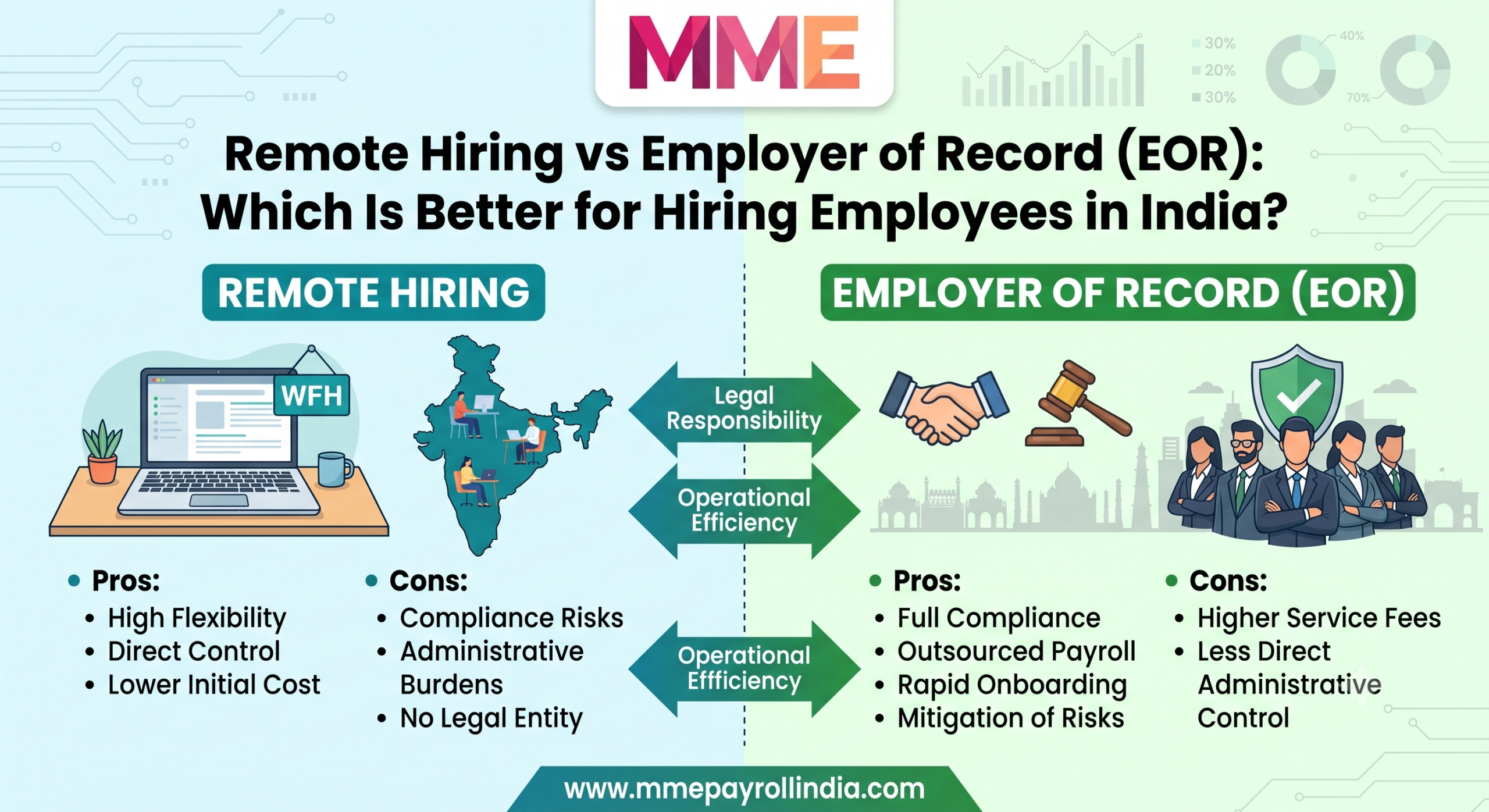
Remote Hiring vs EOR: Understanding the Key Difference
The most important distinction is straightforward.
Remote Hiring
Describes where the employee works.
Employer of Record
Describes how the employee is legally employed and supported.
Many companies mistakenly compare remote work with EOR services when they actually address different workforce needs.
Employees hired through an EOR can still work remotely.
In fact, many international organizations use EOR solutions specifically to build remote teams in India.
Why Global Companies Are Re-Evaluating Remote Hiring Models
The remote work revolution accelerated global hiring.
However, as organizations matured, they began encountering operational challenges.
Common concerns include:
- Workforce administration
- Employment documentation
- Payroll management
- Employee onboarding
- Retention
- Scalability
As a result, many businesses transitioned from informal remote hiring models to structured EOR solutions.
Remote Hiring Challenges in India
Challenge 1: Employment Infrastructure
Organizations often underestimate the administrative work required to support employees effectively.
Employees expect:
- Professional onboarding
- Clear documentation
- Consistent payroll processes
- Reliable support
Without infrastructure, workforce management becomes increasingly complex.
Challenge 2: Payroll Administration
As workforce size increases, payroll administration becomes more demanding.
Organizations must establish systems for:
- Salary processing
- Record management
- Employee communication
- Reporting
Challenge 3: Employee Experience
Top talent expects a professional employment experience.
Employees increasingly evaluate:
- Employment stability
- Administrative support
- Benefits
- Career growth
Organizations that fail to provide these elements often struggle with retention.
Challenge 4: Scalability
Hiring one remote employee is relatively simple.
Managing 10, 25, 50, or 100 employees requires significantly more infrastructure.
Why Employer of Record Solutions Are Growing Rapidly
Employer of Record services address many workforce expansion challenges.
Several factors explain their popularity.
Faster Hiring
Organizations can hire employees quickly without establishing a local entity.
Simplified Workforce Administration
Administrative responsibilities are managed through an experienced local partner.
Better Employee Experience
Structured onboarding and workforce support contribute to employee satisfaction.
Scalability
Organizations can grow teams efficiently.
Workforce Flexibility
Companies can adjust hiring plans as business requirements evolve.
Remote Hiring vs EOR: A Detailed Comparison
Speed to Hire
Remote Hiring
May require internal processes to be developed.
EOR
Provides a ready-made employment infrastructure.
Winner: EOR
Workforce Scalability
Remote Hiring
Increasing workforce size often increases administrative complexity.
EOR
Designed to support workforce growth.
Winner: EOR
Employee Experience
Remote Hiring
Quality varies depending on internal resources.
EOR
Provides structured support and administration.
Winner: EOR
Administrative Burden
Remote Hiring
Managed internally.
EOR
Managed through workforce specialists.
Winner: EOR
Flexibility
Remote Hiring
Offers flexibility for very small teams.
EOR
Supports both flexibility and scalability.
Winner: EOR
Long-Term Workforce Strategy
Remote Hiring
Can become difficult as organizations grow.
EOR
Provides a foundation for sustainable workforce expansion.
Winner: EOR
Which Companies Should Use Remote Hiring?
Remote hiring may be appropriate when:
- Engaging a small number of independent professionals
- Managing short-term projects
- Testing workforce models
- Operating with limited hiring requirements
Which Companies Should Use an EOR?
An EOR is often ideal when:
- Hiring employees in India
- Building long-term teams
- Scaling operations
- Entering India for the first time
- Seeking workforce stability
- Prioritizing employee experience
Industry Examples
SaaS Companies
Technology startups often use EOR services to build distributed engineering teams.
Fintech Organizations
Rapid scaling requires workforce flexibility and operational efficiency.
Semiconductor Companies
Specialized talent acquisition benefits from structured workforce support.
Manufacturing Businesses
Engineering and operational hiring can be accelerated through EOR solutions.
Construction and Infrastructure Firms
Project-based expansion often requires workforce agility.
Why CFOs Prefer EOR Models
Finance leaders typically focus on:
Predictability
Workforce costs become easier to forecast.
Efficiency
Administrative overhead is reduced.
Capital Allocation
Resources can be directed toward growth initiatives.
Risk Management
Organizations avoid many operational complexities associated with workforce administration.
Why HR Leaders Prefer EOR Models
HR teams often benefit from:
- Simplified onboarding
- Employee support
- Workforce documentation
- Scalable hiring processes
- Improved employee experience
Why Global Expansion Leaders Choose EOR
Expansion leaders prioritize:
- Speed
- Scalability
- Flexibility
- Talent access
EOR solutions align closely with these objectives.
Why Recruitment Alone Is No Longer Enough
Historically, organizations relied solely on recruitment agencies.
Today’s workforce environment requires broader capabilities.
Businesses increasingly seek partners offering:
- Recruitment Services
- Employer of Record Solutions
- Workforce Expansion Support
- Payroll Administration
- Talent Consulting
- Global Hiring Strategy
This integrated approach accelerates growth.
Why MM Enterprises Is a Trusted EOR Partner for India Hiring
Through MME Payroll India, global companies gain access to comprehensive workforce expansion solutions designed specifically for international hiring.
Our expertise includes:
- Employer of Record Services
- Payroll Administration
- Workforce Expansion
- Recruitment Solutions
- Executive Search
- Technology Hiring
- Engineering Recruitment
- Global Talent Acquisition
We help organizations hire, onboard, and scale talent across India while reducing operational complexity.
Why Global Companies Choose MM Enterprises
Deep India Market Expertise
Understanding workforce trends across industries.
Access to Exceptional Talent
Extensive recruitment capabilities.
Employer of Record Excellence
Supporting international businesses entering India.
Workforce Scalability
Helping organizations grow efficiently.
Long-Term Strategic Partnership
Focused on sustainable workforce success.
The Future of India Hiring
Several trends are reshaping workforce planning:
- AI adoption
- Global talent shortages
- Distributed work models
- Remote-first operations
- Cross-border workforce expansion
As these trends continue, structured hiring solutions such as EOR services will play an increasingly important role.
Key Takeaways
If your company is considering hiring in India:
- Remote hiring describes where employees work.
- EOR describes how employees are legally employed.
- Remote teams can still be hired through an EOR.
- EOR solutions provide workforce infrastructure, scalability, and support.
- Growing organizations often outgrow informal remote hiring models.
- EOR services help simplify India workforce expansion.
Frequently Asked Questions (FAQs)
Is remote hiring the same as Employer of Record?
No. Remote hiring refers to the employee’s work location, while an EOR provides the legal employment framework.
Can remote employees be hired through an EOR?
Yes. Many global companies use EOR solutions specifically to build remote teams.
Which model is better for hiring employees in India?
For long-term workforce expansion, scalability, and employee experience, many organizations prefer EOR solutions.
Is EOR suitable for startups?
Yes. EOR solutions help startups hire quickly without establishing a local entity.
Can companies transition from EOR to their own entity later?
Yes. Many organizations use EOR services as an initial market entry strategy before establishing a local presence.
Why choose MM Enterprises for India hiring?
MM Enterprises combines recruitment expertise, payroll support, and Employer of Record services to help global businesses scale efficiently in India.
Ready to Build Your Team in India?
Whether you’re evaluating remote hiring, Employer of Record services, or a broader India market entry strategy, choosing the right workforce model can accelerate growth while reducing complexity.
Visit:
Get in Touch:
https://mmepayrollindia.com/get-in-touch/
Read More Workforce Insights:
https://mmepayrollindia.com/blog/
Connect with MM Enterprises today and discover how Employer of Record services can help you hire, onboard, and scale exceptional talent across India—quickly, compliantly, and confidently.