
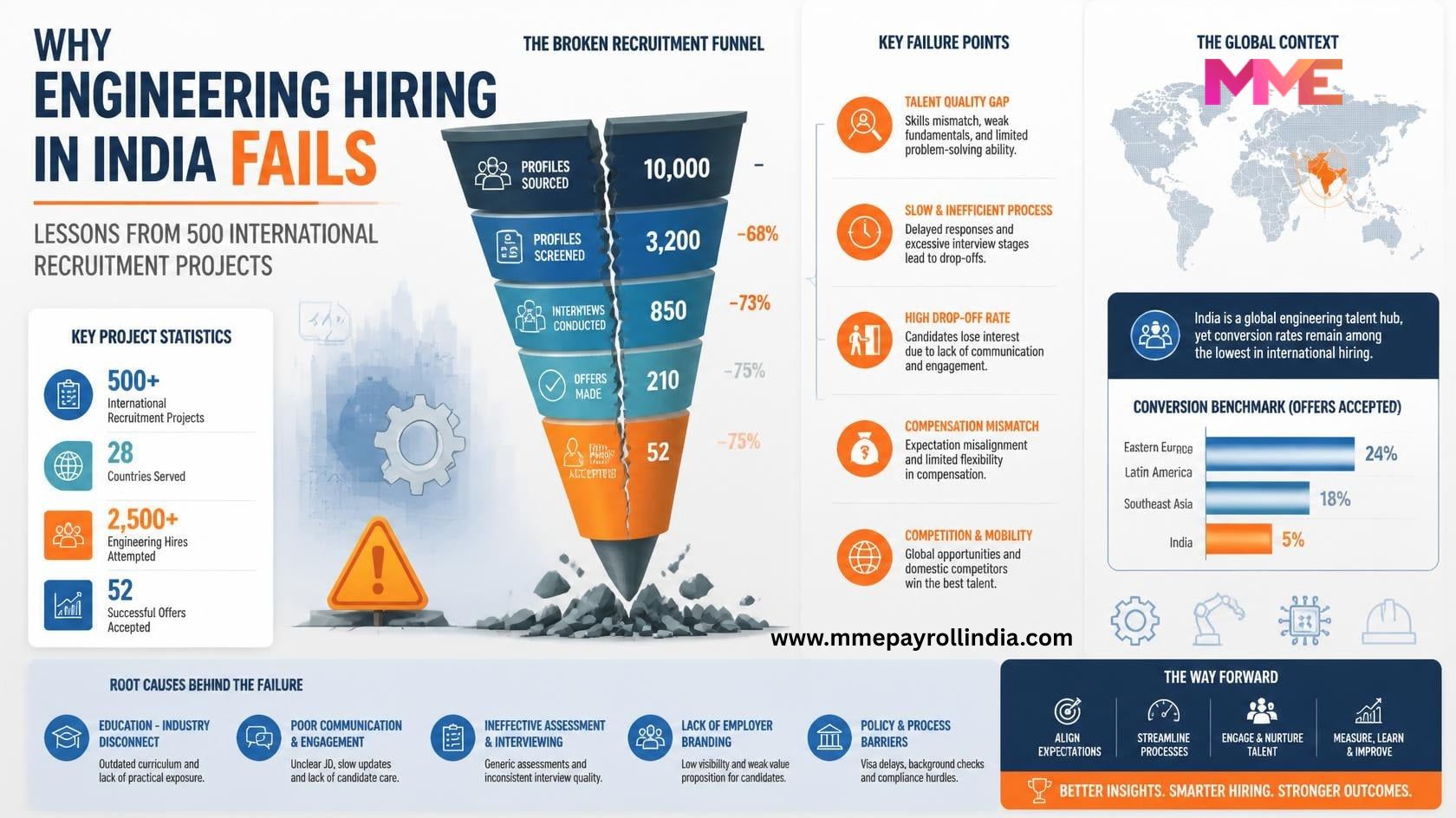
Why Engineering Hiring in India Fails: Lessons from 500 International Recruitment Projects
A Case-Study Style Guide for Global Employers Hiring Engineering Talent in India
Introduction
Engineering talent has become one of the world’s most valuable business assets. Whether organizations are building electric vehicles, developing AI-powered products, expanding semiconductor manufacturing, designing industrial automation systems, or establishing Global Capability Centers (GCCs), their success ultimately depends on hiring the right engineers.
Yet, despite investing significant time and recruitment budgets, many international hiring projects fail to achieve their objectives.
Positions remain vacant for months. Candidates decline offers. Hiring managers restart searches multiple times. Product launches are delayed. Expansion timelines slip. Recruitment costs continue to rise.
The problem is rarely a lack of engineering talent. More often, it is a mismatch between hiring strategy and market realities.
Drawing on lessons observed across hundreds of international recruitment engagements, this article highlights the most common reasons engineering hiring fails and provides practical recommendations for organizations planning Engineering Hiring in India.
Why Engineering Recruitment Has Become More Complex
A decade ago, companies primarily competed within their domestic labor markets.
Today, a robotics engineer in Bengaluru may receive offers from employers in Germany, the United States, Singapore, the United Kingdom, and the Middle East—often at the same time.
Engineering recruitment has evolved into a global competition for specialized skills.
Demand continues to increase across:
- Artificial Intelligence
- Automotive Engineering
- Semiconductor Manufacturing
- Renewable Energy
- Aerospace
- Robotics
- Industrial Automation
- Electronics
- Software Engineering
- Product Development
As organizations expand internationally, recruitment has become a strategic business function rather than simply an HR activity.
Lesson 1: Hiring Starts Too Late
One of the most common challenges in international recruitment is delayed workforce planning.
Many organizations begin searching for engineers only after:
- Customer contracts are signed
- Facilities are operational
- Projects have already started
- Product development deadlines are approaching
This reactive approach creates unnecessary pressure.
Case Insight
A European industrial automation company planned to establish a technical support center in India.
Recruitment began only six weeks before operations were scheduled to commence.
Several specialist automation engineers required extensive notice periods, resulting in delayed onboarding and project implementation.
Best Practice
Develop engineering hiring plans several months before operational milestones.
For specialized engineering positions, proactive talent mapping significantly improves hiring success.
Lesson 2: Job Descriptions Focus on Responsibilities Instead of Outcomes
Many engineering job descriptions contain lengthy lists of responsibilities but fail to explain:
- Business objectives
- Technology roadmap
- Innovation opportunities
- Career progression
- Project impact
Top engineers are attracted to challenging work—not generic job advertisements.
Case Insight
An international electronics manufacturer revised its engineering job descriptions to emphasize product innovation, advanced manufacturing technologies, and long-term career development.
Application quality improved considerably without increasing recruitment spending.
Best Practice
Design engineering job descriptions that communicate business purpose rather than simply listing tasks.
Lesson 3: Salary Benchmarking Is Outdated
Global employers sometimes benchmark salaries using historical compensation data rather than current market conditions.
Emerging sectors such as AI, semiconductor design, EV battery technology, cybersecurity, and robotics experience rapid salary movement.
Case Insight
An overseas technology company budgeted compensation based on salary data collected nearly two years earlier.
Multiple shortlisted candidates accepted competing offers before negotiations concluded.
The issue was not recruitment quality—it was outdated market intelligence.
Best Practice
Conduct current salary benchmarking before launching recruitment campaigns.
Lesson 4: Recruitment Processes Are Too Slow
Engineering professionals often receive multiple interview invitations simultaneously.
Lengthy recruitment processes increase candidate withdrawal rates.
Typical delays include:
- Too many interview rounds
- Slow technical assessments
- Delayed management approvals
- Extended offer preparation
- Poor communication
Case Insight
A multinational engineering organization reduced its recruitment process from six interview stages to three.
Offer acceptance rates increased while overall time-to-hire decreased substantially.
Best Practice
Maintain a structured and efficient recruitment process that allows hiring decisions to be made quickly without compromising quality.
Lesson 5: Companies Recruit Skills Instead of Problem Solvers
Technical expertise alone does not guarantee business success.
The most valuable engineers combine technical capability with:
- Communication
- Collaboration
- Innovation
- Customer understanding
- Leadership potential
- Adaptability
Case Insight
An engineering services company shifted its interview approach from technical questioning alone to structured problem-solving discussions.
New hires demonstrated stronger project performance and greater long-term retention.
Best Practice
Evaluate both technical capability and business impact.
Lesson 6: Ignoring India’s Regional Engineering Strengths
India is not a single engineering talent market.
Different cities have developed specialized engineering ecosystems.
Examples include:
- Bengaluru: AI, Aerospace, Software, Semiconductor Design
- Pune: Automotive, Industrial Automation, Manufacturing Engineering
- Chennai: Automotive, Electronics Manufacturing, Mechanical Engineering
- Hyderabad: Aerospace, Electronics, Medical Devices
- Delhi NCR: Industrial Engineering, Telecommunications, Enterprise Technology
Selecting hiring locations strategically improves recruitment efficiency.
Best Practice
Align hiring locations with engineering specialization rather than office availability.
Lesson 7: Employer Branding Is Overlooked
Engineering professionals evaluate employers carefully before accepting offers.
Candidates often research:
- Technology stack
- Leadership quality
- Innovation culture
- Career growth
- Employee reviews
- Business stability
Organizations with limited employer visibility frequently lose candidates despite offering competitive salaries.
Case Insight
A global product company enhanced its recruitment messaging by highlighting engineering innovation, research investment, and technical leadership.
Candidate engagement increased significantly during subsequent hiring campaigns.
Best Practice
Treat employer branding as part of the recruitment strategy—not a separate marketing initiative.
Lesson 8: Recruitment Partners Are Selected on Cost Alone
Choosing a recruitment partner based solely on pricing often results in:
- Longer hiring timelines
- Poor candidate quality
- Increased replacement hiring
- Higher internal workload
Engineering recruitment requires market expertise, technical understanding, and access to passive candidates.
Best Practice
Evaluate recruitment partners based on industry specialization, delivery capability, candidate networks, and hiring outcomes.
Lesson 9: Workforce Planning Ends After Hiring
Successful engineering recruitment extends beyond offer acceptance.
Organizations should prepare for:
- Structured onboarding
- Technical mentoring
- Continuous learning
- Leadership development
- Career progression
- Employee engagement
Retention begins during recruitment—not after joining.
Lessons Learned from International Recruitment Projects
Across international engineering recruitment initiatives, several consistent themes emerge:
- Early workforce planning delivers better hiring outcomes.
- Competitive compensation must reflect current market conditions.
- Specialized recruitment strategies outperform generic hiring approaches.
- Faster decision-making improves candidate acceptance.
- Strong employer branding attracts higher-quality engineering professionals.
- Long-term retention planning is as important as recruitment itself.
Organizations that integrate these principles consistently reduce hiring risks and improve workforce quality.
Why India Continues to Lead International Engineering Recruitment
India remains one of the preferred destinations for international engineering hiring because of its:
- Large engineering workforce
- Strong technical education ecosystem
- Mature software and product engineering industry
- Growing semiconductor and electronics sectors
- Expanding Global Capability Centers
- Competitive operating costs
- English-speaking professionals
- Experience supporting multinational organizations
From AI and automotive engineering to industrial automation and renewable energy, India offers access to specialized engineering talent across multiple industries.
However, successful Engineering Hiring in India requires local market knowledge, accurate salary benchmarking, and an understanding of regional talent ecosystems.
How MME Enterprises Supports International Engineering Recruitment
At MM Enterprises, we help global organizations build high-performing engineering teams across India through specialized recruitment solutions tailored to business objectives.
Our expertise includes:
- Engineering Hiring in India
- International Recruitment
- Executive Search
- AI & Technology Recruitment
- Automotive Engineering Recruitment
- Semiconductor Recruitment
- Manufacturing Recruitment
- Renewable Energy Recruitment
- Global Capability Center (GCC) Hiring
- Workforce Planning
- Talent Mapping
- Salary Benchmarking
Whether you are hiring a single engineering leader or establishing a large engineering center, our recruitment specialists combine industry expertise with deep market knowledge to help organizations recruit faster, reduce hiring risks, and build sustainable engineering teams.
Learn more at www.mmenterprises.co.in
Frequently Asked Questions (FAQs)
1. Why do international engineering recruitment projects often fail?
The most common reasons include delayed workforce planning, slow hiring processes, outdated salary benchmarks, weak employer branding, and a lack of understanding of local engineering talent markets.
2. Why is India a preferred destination for engineering hiring?
India offers one of the world’s largest engineering talent pools, strong technical education, competitive hiring costs, and specialized expertise across software, AI, automotive, manufacturing, semiconductor, and industrial engineering.
3. Which industries benefit most from Engineering Hiring in India?
Technology, automotive, aerospace, manufacturing, renewable energy, electronics, semiconductor, industrial automation, healthcare technology, and engineering consulting organizations all benefit from India’s engineering workforce.
4. How can companies improve international engineering recruitment success?
Organizations should begin workforce planning early, benchmark salaries regularly, streamline hiring processes, strengthen employer branding, and work with experienced engineering recruitment specialists.
5. Why partner with MM Enterprises for International Recruitment?
MM Enterprises specializes in Engineering Hiring in India and International Recruitment, helping global employers identify, assess, and recruit highly skilled engineering professionals while reducing hiring timelines and ensuring access to quality talent across India’s leading engineering hubs.
People also search us as : Engineering Hiring in India, International Recruitment, Engineering Recruitment India, Global Engineering Recruitment, Technical Recruitment, Engineering Talent Acquisition, Recruitment Consultants in India, Engineering Jobs India, Executive Search, Global Hiring Strategy.