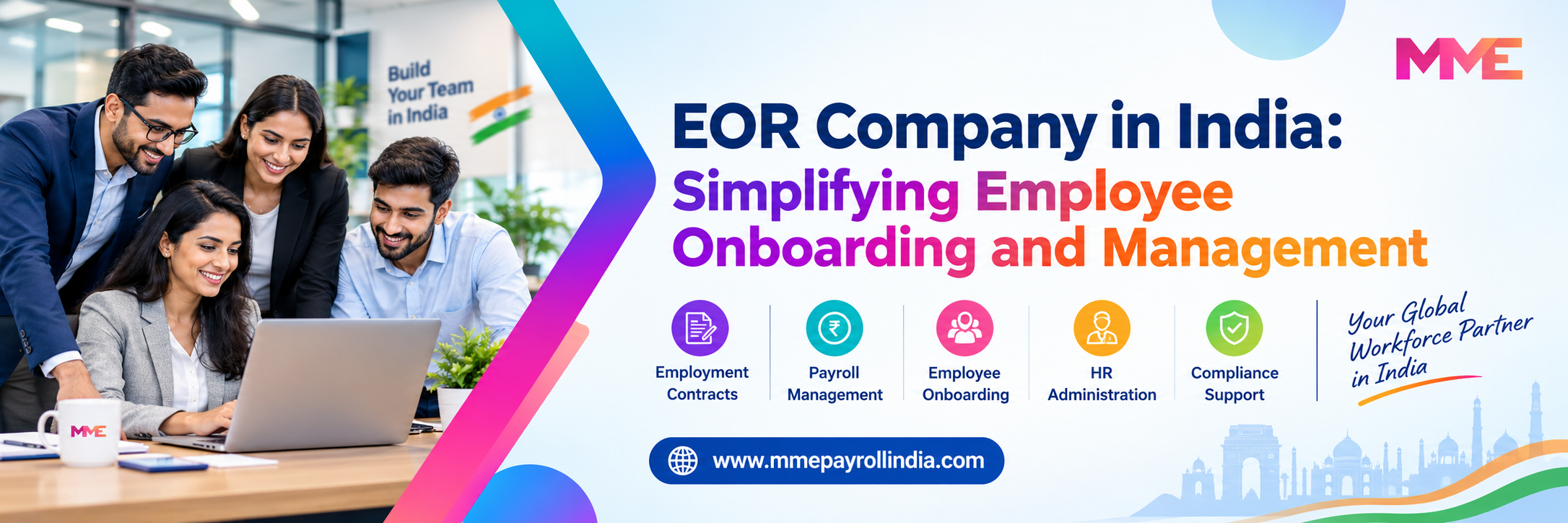
An EOR company in India enables international businesses to hire employees and manage employment administration without necessarily establishing their own local employing entity. An Employer of Record (EOR) manages agreed responsibilities such as employment contracts, payroll coordination, onboarding documentation, and HR administration, while the client company typically manages the employees’ day-to-day work.
For organisations looking to expand into India, managing these responsibilities internally can require time, local expertise, and well-organised systems. Founded in 1994, M M Enterprises (MME) provides payroll, PEO, and EOR solutions to support organisations with their workforce requirements.
How an EOR Company in India Simplifies Employee Onboarding:
An EOR company in India simplifies employee onboarding by coordinating employment documents, payroll setup, required employee information, and agreed HR administration. A structured onboarding process helps international companies organise employment responsibilities and reduce avoidable administrative delays while focusing on business operations and employee performance.
What Is an EOR Company in India?
An Employer of Record (EOR) is a third-party service provider that formally employs workers for a client company under a contractual arrangement.
Depending on the agreement, an EOR may handle the following responsibilities:
- Preparing and managing employment contracts.
- Coordinating employee onboarding paperwork.
- Setting up payroll and managing salary administration.
- Maintaining agreed employment records and documentation.
- Supporting employee onboarding and HR administration.
- Coordinating applicable statutory and employment compliance requirements.
The client company typically directs employees’ day-to-day duties, work priorities, team collaboration, and performance, subject to the agreed arrangement and applicable law.
For international companies looking to hire in India, an EOR arrangement may provide an alternative to establishing a local employing entity. However, its suitability depends on the company’s activities, workforce structure, and legal and tax circumstances.
Why Is Employee Onboarding Important for International Companies?
Employee onboarding involves more than collecting documents and issuing an offer letter. It establishes the administrative and operational framework for the employee’s relationship with the organisation.
Without clearly defined onboarding responsibilities, companies may experience delayed start dates, incomplete paperwork, payroll setup problems, and confusion about workplace policies or reporting lines.
A well-organised onboarding process helps companies:
1. Organise Employment Documents
Employees need clear employment terms and the appropriate documentation for their roles. A defined process helps manage employment contracts, employee information, and required paperwork efficiently.
2. Prepare Payroll Before the Joining Date
Accurate salary details, payment information, and applicable deductions or benefits are important for payroll setup. Collecting and checking these details in advance can help prevent unnecessary delays in the first payroll cycle.
3. Define Roles and Responsibilities
Employees should understand their responsibilities, reporting managers, work arrangements, and relevant company policies. Clear communication helps new hires prepare for their roles and settle into the organisation.
4. Manage HR Administration
A structured process establishes who will handle employee questions, documentation, payroll coordination, and other administrative tasks. This is particularly useful when the client company and employees are located in different countries.
How Can an EOR Company Simplify the Employee Onboarding Process in India?
An EOR can coordinate the employment administration needed to bring a new employee on board. The exact responsibilities depend on the agreed service scope.
Step 1: Confirm the Employment Requirements
The client company shares details about the role, salary, work location, reporting authority, expected joining date, and other relevant employment terms.
Before onboarding begins, the EOR and client company should agree on their respective responsibilities and approval processes.
Step 2: Prepare Employment Documentation
The relevant employment documentation is prepared and reviewed through the agreed process. This may include employment terms, job responsibilities, remuneration details, and applicable policies.
Documentation should reflect the actual employment arrangement and comply with applicable legal requirements.
Step 3: Collect and Verify Employee Information
During onboarding, the required employee information and supporting documents are collected and checked.
The parties should establish procedures for collecting, accessing, storing, and protecting employee information. A defined checklist can help reduce missing information and repeated requests.
Step 4: Establish Payroll Administration
The EOR coordinates the information required for payroll, including agreed salary terms, payment schedules, and applicable deductions or contributions.
The client company and EOR should confirm payroll cut-off dates, approval procedures, and processes for managing changes to employee information.
Step 5: Organise the Joining Process
Before the employee starts work, the parties should confirm the joining date, reporting manager, equipment or systems required, communication channels, and relevant induction activities.
This helps distinguish employment administration responsibilities from the operational onboarding duties managed by the client company.
Step 6: Continue Employee Administration
After onboarding, the EOR may manage agreed administrative activities such as payroll coordination, employment records, personnel changes, and HR administration.
The client company should retain clear internal responsibility for day-to-day management, work allocation, performance feedback, and team integration.
What Employee Administration Services Can an EOR Offer?
Employee administration includes the processes that help keep employment records accurate and coordinate workforce-related activities.
Depending on the service agreement, an EOR may provide the following support:
| Administration area | Typical activities |
| Employment documentation | Preparing and maintaining agreed employment records |
| Payroll administration | Coordinating salary processing and payroll information |
| Employee records | Maintaining required employment information |
| Leave and benefits administration | Coordinating applicable policies, records, and benefits |
| Employee changes | Processing agreed changes to salary, role, or personal details |
| HR support | Responding to employment administration queries within the agreed scope |
| Offboarding | Assisting with final documentation, payroll processes, and employment closure procedures |
Not every EOR provider includes all these services in its standard package. Companies should confirm the service scope, responsibilities, timelines, and costs before signing an agreement.
EOR vs Payroll Outsourcing: What Is the Difference?
EOR and payroll outsourcing are related but distinct workforce services. The appropriate option depends on who employs the workers and which responsibilities the company wants to outsource.
| Area | Employer of Record (EOR) | Payroll outsourcing |
| Employment relationship | The EOR is the formal employer under the agreed arrangement | The client company typically remains the employer |
| Employment contracts | The EOR may manage employment contracts | The client company typically remains responsible for employment contracts |
| Payroll processing | Included within the agreed EOR scope | The primary focus is payroll processing |
| HR administration | May include agreed employment administration | Generally focuses on agreed payroll-related activities |
| Best suited for | Businesses seeking an employment arrangement with associated administration | Employers with an existing employment structure that need payroll support |
Another workforce service model is a Professional Employer Organisation (PEO). Businesses should confirm the actual contractual arrangement instead of treating EOR, PEO, and payroll outsourcing as interchangeable terms, since their responsibilities and legal frameworks may differ.
Five Common Employee Onboarding Problems and How to Fix Them
1. Missing Employee Documentation
Challenge: Incomplete or inaccurate information may delay onboarding and payroll processing.
Solution: Use a consistent checklist, assign responsibility for each document, and establish deadlines before the employee’s joining date.
2. Payroll Setup Delays
Challenge: Unclear payroll cut-off dates and late salary information can create avoidable administrative problems.
Solution: Confirm remuneration details, payment information, approval processes, and payroll schedules before the employee starts work.
3. Unclear Responsibilities
Challenge: The client company and service provider may each assume that the other party is responsible for a particular task.
Solution: Clearly assign responsibility for employment contracts, payroll inputs, employee queries, leave information, approvals, and operational onboarding.
4. Different Time Zones and Communication Issues
Challenge: Employees, managers, and service providers may be located in different countries and time zones, making coordination difficult.
Solution: Establish communication channels, response expectations, escalation contacts, and deadlines for time-sensitive tasks.
5. Inaccurate or Insecure Employee Data
Challenge: Employee information includes personal and employment-related details that must be handled responsibly.
Solution: Use secure information-sharing procedures, restrict access to authorised users, verify information carefully, and follow applicable data protection requirements.
How MME Payroll India Can Help Your Business
Founded in 1994, M M Enterprises (MME) provides payroll, PEO, and EOR services to organisations with workforce requirements in India and international markets.
MME Payroll India can discuss your employee administration requirements and help identify a suitable service arrangement for your organisation.
Depending on the agreed scope, the discussion may cover:
- EOR arrangements for hiring employees in India.
- Coordination of employee onboarding and employment documentation.
- Payroll processing and administration.
- Employee records and personnel administration.
- Workforce requirements of international businesses.
- Responsibilities shared between the client company and service provider.
Before proceeding, businesses should confirm which services are included, the associated costs, expected onboarding timelines, reporting arrangements, and how employment responsibilities are allocated.
Frequently Asked Questions
1. What does an EOR company do in India?
An EOR company formally employs workers for a client under an agreed contractual arrangement. It may manage employment contracts, payroll, onboarding documentation, and other employment administration tasks. The precise scope depends on the contract and applicable law.
2. Is EOR a suitable way for a foreign company to hire employees in India?
An EOR arrangement may allow a foreign company to hire employees in India without immediately establishing its own local employing entity. Its suitability depends on the company’s business activities, legal structure, tax position, and employment requirements.
3. How does an EOR simplify employee onboarding?
An EOR can coordinate employee documentation, employee information, payroll setup, and agreed HR administration. A clearly defined process helps establish responsibilities and reduce avoidable administrative delays.
4. Is EOR the same as payroll outsourcing?
No. An EOR provides a formal employment arrangement and manages agreed employer responsibilities. Payroll outsourcing generally focuses on salary processing and related administration for employees of the client company.
5. What documents are required for EOR onboarding in India?
Requirements depend on the employee’s circumstances, role, and employment arrangement. Documents may include identity and tax information, bank details, employment documentation, and other records required for payroll and employment administration. The provider should confirm the applicable checklist.
6. Can an EOR manage ongoing employee administration?
Yes, an EOR may manage agreed activities such as payroll coordination, employment records, personnel changes, and HR administration. Businesses should review the service agreement to understand what is included and which responsibilities they retain.
7. How should a business choose an EOR company in India?
Evaluate the provider’s experience, service scope, payroll capabilities, onboarding process, data protection practices, communication procedures, pricing, and contractual terms. Ask how employee queries are handled and how responsibilities are divided between the provider and your business.
Conclusion: Choose an EOR Company in India for Organised Employee Management
An EOR company in India can help international businesses coordinate employee onboarding, employment documentation, payroll, and ongoing administration under a defined service agreement. The right approach depends on the company’s hiring plans, employment structure, and operational requirements.
Founded in 1994, M M Enterprises (MME) provides payroll, PEO, and EOR services to support businesses with their workforce needs.
Looking to hire employees in India or improve your current onboarding process?
Contact MME Payroll India to discuss your requirements and explore a suitable EOR or payroll service arrangement.