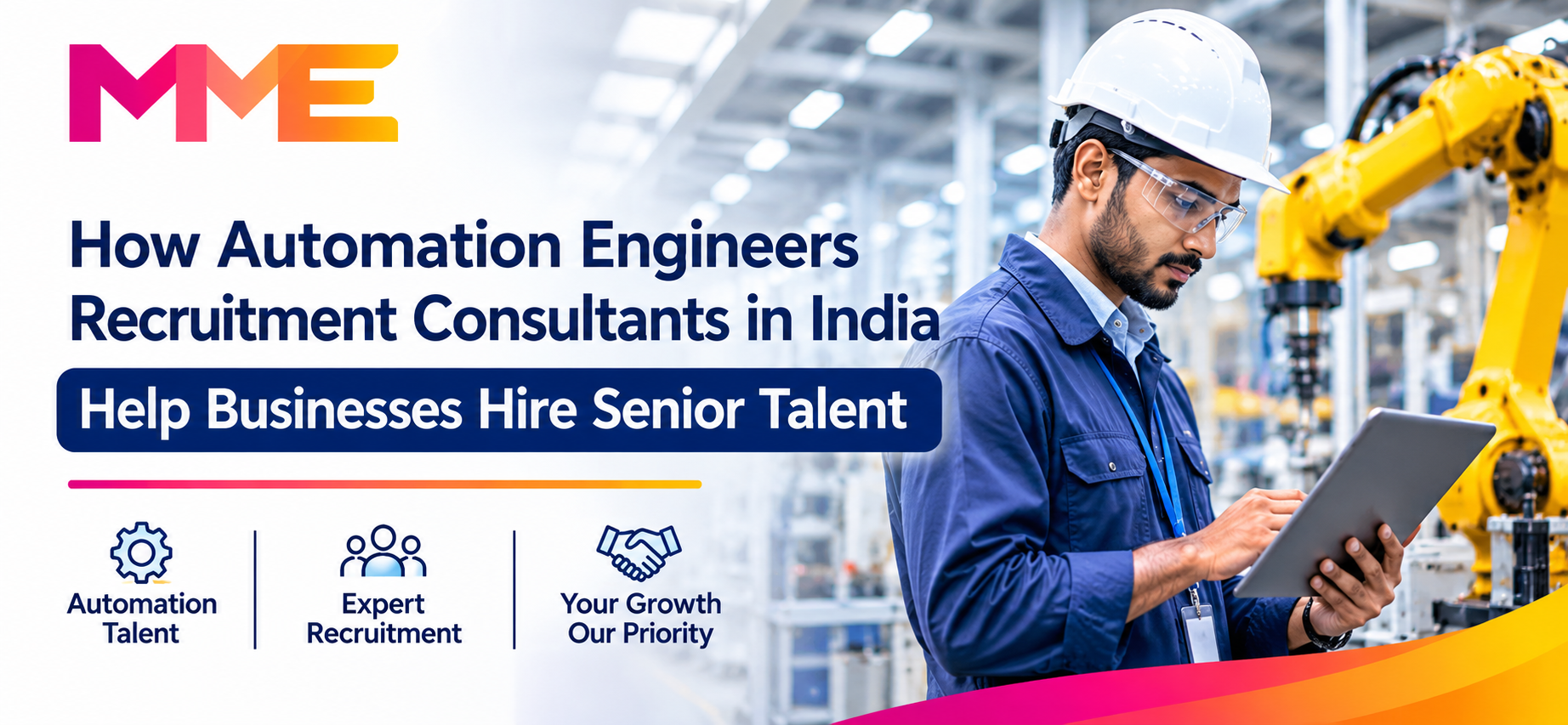
How Automation Engineers Recruitment Consultants in India Help Businesses Hire Senior Talent
Industrial automation is changing how manufacturing companies design, operate and manage production facilities. Businesses are investing in robotics, programmable logic controllers (PLCs), supervisory control and data acquisition (SCADA), industrial control systems and smart manufacturing technologies.
However, implementing these technologies successfully requires more than purchasing advanced equipment. Companies also need experienced professionals who can design, integrate, manage and maintain complex automation systems.
This is where automation engineers recruitment consultants in India can support businesses by identifying experienced engineering professionals for specialist, mid-level and senior management positions.
For manufacturing companies, engineering businesses and international organisations expanding their operations in India, finding the right automation talent is essential for maintaining production efficiency, improving operational performance and supporting long-term business growth.
How Can Automation Engineers Recruitment Consultants in India Help Businesses?
Automation engineering recruitment consultants help organisations identify and recruit qualified professionals with the technical knowledge and industry experience required for industrial automation projects.
Their recruitment approach may include:
- Identifying experienced industrial automation engineers.
- Recruiting PLC, SCADA and robotics specialists.
- Finding control systems and instrumentation engineers.
- Hiring automation project managers and engineering leaders.
- Conducting technical experience and industry background screening.
- Identifying mid-level and senior professionals for specialised positions.
Unlike general recruitment, specialist engineering recruitment focuses on understanding the technology, project requirements, industry experience and responsibilities associated with each position.
Why Is Industrial Automation Talent Important for Modern Businesses?
Industrial automation plays an important role in manufacturing, automotive production, pharmaceuticals, electronics, engineering, food processing and industrial equipment manufacturing.
Companies use automation systems to improve production consistency, reduce manual intervention, monitor equipment performance and manage complex manufacturing processes.
However, automation projects require professionals who understand both engineering principles and practical industrial applications.
For example:
- An automotive manufacturer may require robotics engineers to manage automated assembly operations.
- An electronics manufacturer may need PLC and SCADA professionals to support production equipment.
- A pharmaceutical company may require process automation engineers familiar with controlled manufacturing environments.
- An industrial equipment manufacturer may need control systems engineers for machinery integration.
The hiring requirement changes according to the production environment, technology and business objectives.
This makes specialised recruitment particularly important when companies need professionals who can contribute from the beginning of a project.
Which Industrial Automation Professionals Should Businesses Hire?
Companies should identify the required technical specialisation before beginning recruitment. Automation engineering includes several professional categories.
1. PLC and SCADA Engineers
PLC and SCADA professionals work with industrial control and monitoring systems.
Their responsibilities may include:
- PLC programming and troubleshooting.
- SCADA configuration and monitoring.
- Control panel integration.
- Industrial equipment automation.
- System testing and commissioning.
Companies should evaluate practical experience with the specific PLC platforms, control systems and applications used at their facilities.
2. Robotics and Industrial Automation Engineers
Robotics engineers help organisations implement automated machinery and robotic systems.
Relevant experience may include:
- Industrial robot programming.
- Robotic system integration.
- Automated assembly lines.
- Machine vision applications.
- Production process optimisation.
Automotive, electronics and industrial manufacturing businesses frequently require these specialised capabilities.
3. Control Systems and Instrumentation Engineers
These professionals work with industrial measurement, control and monitoring systems.
Their expertise may cover:
- Distributed Control Systems (DCS).
- Process instrumentation.
- Control system design.
- Industrial sensors and transmitters.
- Process monitoring and troubleshooting.
Their experience is particularly relevant to process industries and complex manufacturing environments.
4. Automation Project Managers
Automation project managers coordinate the implementation of automation projects.
They may be responsible for:
- Project planning and execution.
- Managing engineering teams.
- Coordinating vendors and system integrators.
- Monitoring project budgets and timelines.
- Supporting testing and commissioning.
Companies implementing new manufacturing facilities or upgrading existing production systems may require experienced project leaders.
5. Senior Automation Managers and Engineering Heads
Senior automation professionals are responsible for wider engineering and operational decisions.
Typical responsibilities include:
- Developing automation strategies.
- Managing engineering departments.
- Leading technology implementation.
- Improving production systems.
- Managing capital expenditure projects.
- Coordinating cross-functional engineering teams.
These positions often require executive search rather than relying exclusively on general job advertisements.
Why Do Companies Need an Automation Engineer Recruitment Agency in India?
Recruiting experienced automation professionals can be challenging because job titles alone do not explain a candidate’s actual technical capabilities.
Two candidates may both be described as automation engineers, but their experience could be completely different. One may specialise in PLC programming, while another may manage large-scale robotics integration projects.
A specialised automation engineer recruitment agency in India can help businesses address several hiring challenges.
1. Limited Access to Relevant Technical Talent
Experienced professionals may already be employed in manufacturing companies, automation solution providers or engineering organisations.
Many are not actively applying for advertised vacancies.
Targeted candidate research and professional networking can help companies reach suitable passive candidates.
2. Difficulty Evaluating Technical Experience
A candidate’s CV may mention PLC, SCADA, robotics or industrial automation without explaining the complexity of their actual work.
Employers should evaluate:
- Technologies and platforms handled.
- Project size and complexity.
- Industry exposure.
- Equipment and systems implemented.
- Team management responsibilities.
- Troubleshooting and commissioning experience.
Technical interviews conducted by qualified engineering stakeholders should support the recruitment process.
3. Hiring Mid-Level and Senior Professionals
Hiring an experienced automation manager requires a different approach from recruiting an entry-level engineer.
Senior candidates should be assessed for technical decision-making, project leadership, budget management, vendor coordination and team development.
Executive search helps companies identify professionals whose experience matches these responsibilities.
4. International Companies Hiring in India
Foreign companies establishing manufacturing operations, engineering centres or technical teams in India may not have an established local recruitment network.
An experienced recruitment partner can help identify relevant candidates across Indian talent markets and coordinate the recruitment process.
How Do Industrial Engineering Recruitment Consultants Identify Suitable Candidates?
A structured recruitment process helps reduce irrelevant applications and improves the quality of candidate shortlists.
The following steps are useful for businesses hiring specialist automation professionals.
Step 1: Understand the Business Requirement
Start by defining the actual business need.
For example, does the company need someone to develop a new automation system, manage an existing production facility or lead a large engineering team?
The answer determines the experience and seniority required.
Step 2: Prepare a Detailed Technical Job Description
A useful job description should include:
- Job title and reporting structure.
- Required engineering qualification.
- Relevant years and type of experience.
- Automation platforms and technologies.
- Industry background.
- Project responsibilities.
- Team management requirements.
- Location and travel expectations.
Avoid using broad descriptions such as simply requiring an automation engineer.
Step 3: Conduct Targeted Talent Mapping
Identify companies and industries where relevant professionals are likely to work.
Potential talent sources include:
- Automotive manufacturing.
- Industrial machinery.
- Electronics manufacturing.
- Engineering and automation solution providers.
- Pharmaceuticals and process industries.
- Robotics and system integration companies.
This approach helps recruiters understand the available talent market before approaching candidates.
Step 4: Screen Candidates for Relevant Experience
Evaluate candidates against the employer’s technical and managerial requirements.
Shortlisting should consider actual project contributions, technology expertise, industry exposure and career progression rather than job titles alone.
Step 5: Coordinate Interviews and Selection
Arrange interviews with the appropriate technical and HR stakeholders.
For senior positions, employers should also evaluate leadership capabilities, communication, decision-making and the candidate’s ability to manage business-critical projects.
Step 6: Support Offer Management and Joining
Once the employer selects a candidate, coordinate compensation discussions, documentation, offer acceptance and joining formalities.
A structured process helps maintain communication between the employer and selected professional.
What Should Businesses Check Before Hiring an Automation Engineering Professional?
Technical knowledge is important, but employers should also evaluate how candidates apply that knowledge in actual industrial environments.
Consider the following assessment areas:
| Assessment area | What employers should evaluate |
| Technical expertise | PLC, SCADA, DCS and robotics experience |
| Project experience | Previous installations, upgrades and commissioning |
| Industry knowledge | Automotive, electronics, pharmaceuticals or manufacturing |
| Problem-solving | Troubleshooting and system optimisation |
| Leadership | Experience managing engineering teams |
| Project management | Budget, vendors, delivery and timelines |
| Safety awareness | Understanding of industrial safety requirements |
| Cybersecurity awareness | Knowledge of industrial control system security |
For relevant roles, employers can also consider professional credentials such as ISA’s Certified Automation Professional (CAP). However, certification should complement practical experience rather than replace technical assessment.
Common Mistakes to Avoid When Recruiting Automation Engineers
Businesses can improve recruitment outcomes by avoiding these common mistakes:
- Using generic job descriptions: Clearly mention the automation platforms, project requirements and industry experience needed.
- Focusing only on years of experience: Evaluate the candidate’s actual technical responsibilities and project achievements.
- Ignoring industry background: Experience in one manufacturing environment may not automatically translate to another.
- Overlooking leadership skills: Senior automation positions require people management, planning and decision-making capabilities.
- Relying only on job portals: Passive candidates may be more relevant for specialised and senior positions.
- Delaying interview decisions: Long selection processes can make it difficult to retain the interest of experienced professionals.
How M M Enterprises Supports Industrial Automation Recruitment in India
M M Enterprises has been established since 1994 and supports organisations with recruitment and workforce solutions across domestic and international markets.
Companies looking to recruit industrial automation professionals can benefit from a structured recruitment approach based on their technical requirements, industry background and seniority expectations.
MME’s recruitment support covers specialised engineering and manufacturing recruitment, management recruitment and executive search requirements.
Depending on the employer’s hiring needs, recruitment support may include identifying:
- Senior Automation Engineers.
- Automation Engineering Managers.
- PLC and SCADA Specialists.
- Robotics Engineers.
- Control Systems Engineers.
- Automation Project Managers.
- Engineering Heads and Technical Leaders.
For international companies hiring in India, MME can also support wider workforce requirements through relevant Employer of Record (EOR), payroll and remote hiring solutions.
The recruitment requirement and employment arrangement can be discussed separately to determine the appropriate approach for each business.
Planning to hire experienced industrial automation professionals in India?
Share your job requirements, preferred experience level, technical specialisation and hiring location with M M Enterprises. Our team can discuss a suitable recruitment approach for your organisation.
Conclusion
Industrial automation requires professionals who understand technology, manufacturing processes and real-world engineering challenges.
Finding the right people for these positions requires a focused recruitment strategy that considers technical expertise, project experience, industry exposure and leadership capabilities.
Working with automation engineers recruitment consultants in India can help businesses access specialised engineering talent, improve candidate shortlisting and support important recruitment decisions.
Whether your organisation needs an experienced PLC engineer, robotics specialist, automation project manager or senior engineering leader, defining the right hiring requirement is the first step towards building a capable technical team.
Frequently Asked Questions
1. What do automation engineers recruitment consultants in India do?
They help companies identify, evaluate and recruit professionals specialising in industrial automation, PLC, SCADA, robotics, control systems and automation project management.
2. How can I hire experienced industrial automation engineers in India?
Define the technical requirements, identify relevant industries, assess candidates for practical project experience and conduct technical interviews. Specialist engineering recruitment consultants can support talent mapping and candidate shortlisting.
3. Which industries require industrial automation engineers?
Automotive, electronics, pharmaceuticals, industrial machinery, food processing, chemicals, engineering and manufacturing companies require automation professionals for different production and control applications.
4. What is the difference between an automation engineer and an automation project manager?
An automation engineer generally focuses on designing, programming, integrating or maintaining automation systems. An automation project manager coordinates project planning, engineering teams, vendors, budgets and implementation timelines.
5. Can recruitment agencies help companies hire senior automation managers?
Yes. Specialist recruitment agencies can use targeted talent mapping and executive search methods to identify experienced automation managers, engineering heads and technical leaders.
6. Can international companies recruit automation engineers in India?
Yes. International companies can recruit Indian automation professionals for manufacturing facilities, engineering centres and other business operations. They should also determine the appropriate local employment and compliance arrangements.
7. Why should businesses work with industrial engineering recruitment consultants?
Specialist consultants can help employers understand technical requirements, identify relevant candidates, assess industry experience and coordinate recruitment for mid-level and senior engineering positions.